




Billable hours are up. Your RBT team has grown. Your billing report looks like the best year the clinic has ever had.
And your bank account looks like a practice half your size.
If you own an ABA practice, you know exactly how that happens. Claims can take 30 to 90 days to pay, and longer when a payer falls behind. Meanwhile, payroll goes out every two weeks.
Which leads to a question that worries a lot of clinic owners every fall: “Am I going to owe taxes on money I haven’t even received?”
How are ABA therapy practices taxed when payments arrive late?
Most ABA practices use the cash method of accounting, which means you’re taxed on what you collect during the year.
Under the cash method, income is generally reported in the year you actually receive it (IRS Publication 538). Claims sitting in accounts receivable on December 31 generally aren’t taxable until the payment arrives. So, in most cases, you won’t owe tax on money you haven’t collected.
But that creates a different planning problem. Your tax bill depends on when your payers pay you. And for many ABA practices, that timing is out of your hands.
Why does payer timing create such big tax swings in ABA?
ABA practices rely on insurance and Medicaid more heavily than most healthcare specialties. State Medicaid programs can change rates, authorization rules, and processing timelines with little notice.
The Flychain 2026 ABA Practice Financial Benchmark Report recommends that no single payer make up more than 40% of your revenue. Above that, one payer’s delay can move your whole year.
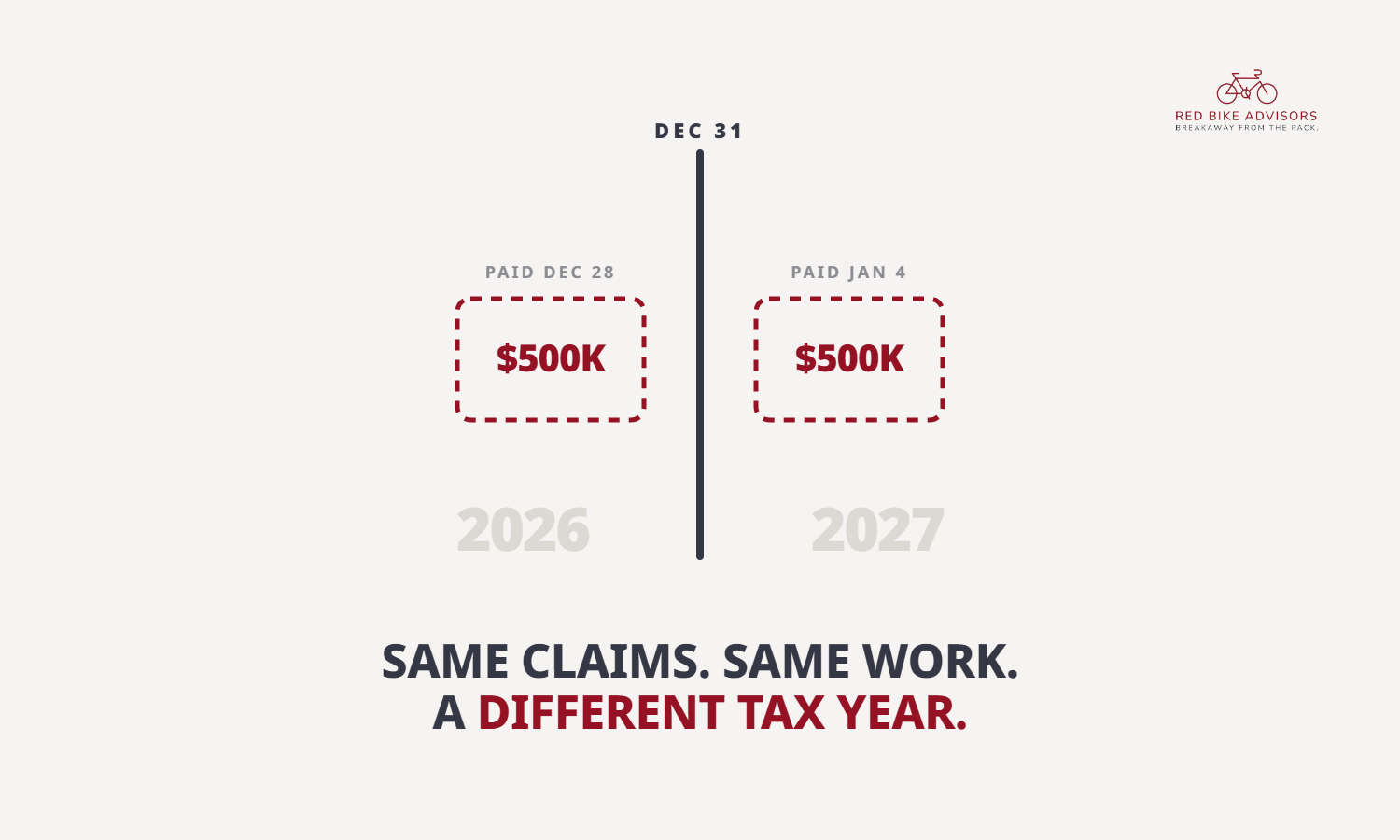
Here’s what that looks like at tax time. If a $500,000 backlog clears on December 28, that’s $500,000 of taxable income in 2026. If it clears on January 4, it lands in 2027. Same claims. Same work. A completely different tax year.
Can you delay billing to push income into next year?
No, and please don’t try.
Payers have timely filing limits. Holding claims can mean losing them entirely, and it can raise compliance questions you never want to answer. Your billing should always run on clinical and contractual timelines.
The planning happens around your collections.
How do you plan when you can’t predict the payment date?
You plan for both outcomes. In October, build a two-scenario projection:
- Scenario A: the backlog clears before December 31
- Scenario B: the backlog clears in January
Here’s how the math works for a clinic on pace for about $3.2 million in revenue, with about $540,000 of Medicaid claims more than 60 days old.
In Scenario A, that $540,000 lands in 2026. At a top federal bracket, that could mean roughly $190,000 more in federal tax for the year. In Scenario B, that tax shifts to 2027.
From there, the plan is straightforward:
- Estimated payments sized to the safe harbor, so you’re protected from penalties in either scenario
- A separate tax reserve that grows automatically if the backlog clears in December
- Year-end deductions ready to go if Scenario A happens, and on hold if Scenario B happens
You stop waiting for Medicaid to decide your tax year. You have a plan for either answer.
What does late payment do to your cash while you wait?
This is the other half of the problem. Your RBTs get paid every two weeks, whether your payers do or not.
The Flychain 2026 benchmarks recommend keeping two to three payrolls of cash on hand, with direct clinical labor at or below 50% of revenue. When clinical labor creeps higher and collections slow down, a practice can be profitable on paper and short on payroll in real life.
That’s why your tax reserve needs to live in a separate account. If it sits in operating cash, it will get spent covering payroll during the next backlog.
Should an ABA practice switch to accrual accounting?
For taxes, cash basis is usually the better fit for a practice your size. It keeps your tax bill tied to money you actually have.
For running the clinic, accrual-style reporting is valuable. Knowing what you’ve billed, what’s outstanding, and which payers are slow tells you far more about practice health than a bank balance.
The best setup is often both: cash basis on your tax return, and monthly management reports that show billing, receivables, and gross margin. The Flychain 2026 benchmarks put a healthy ABA gross margin at 40% or higher, with strong operators at 45% to 50%.
What should an ABA practice owner review in October?
- Accounts receivable aging, broken out by payer
- Which payers are running slow and by how much
- A two-scenario tax projection for year-end
- Your cash runway, measured in payrolls
- Your payer mix against the 40% concentration benchmark
In an ABA practice, your tax bill follows your collections, and your collections follow your payers. The practices that stay calm in April plan for both.