
Do Healthcare Practice Owners Qualify for the 20% QBI Deduction?

By Gretchen Roberts
Picture two owners with the same profit.
One runs an HVAC company. The other runs a healthcare practice. Every year, the HVAC owner takes a deduction worth 20% of his business income, and it shaves thousands off his tax bill.
The practice owner hears the words "specified service" from her accountant and assumes the door is closed.
Sometimes it is. But the answer depends on one number you can still influence this year.
Do healthcare practice owners qualify for the QBI deduction?
Yes, but only below certain income levels.
The qualified business income (QBI) deduction, under Section 199A, lets owners of pass-through businesses deduct up to 20% of their business income. Healthcare is classified as a specified service trade or business (SSTB), and SSTBs get a special limit.
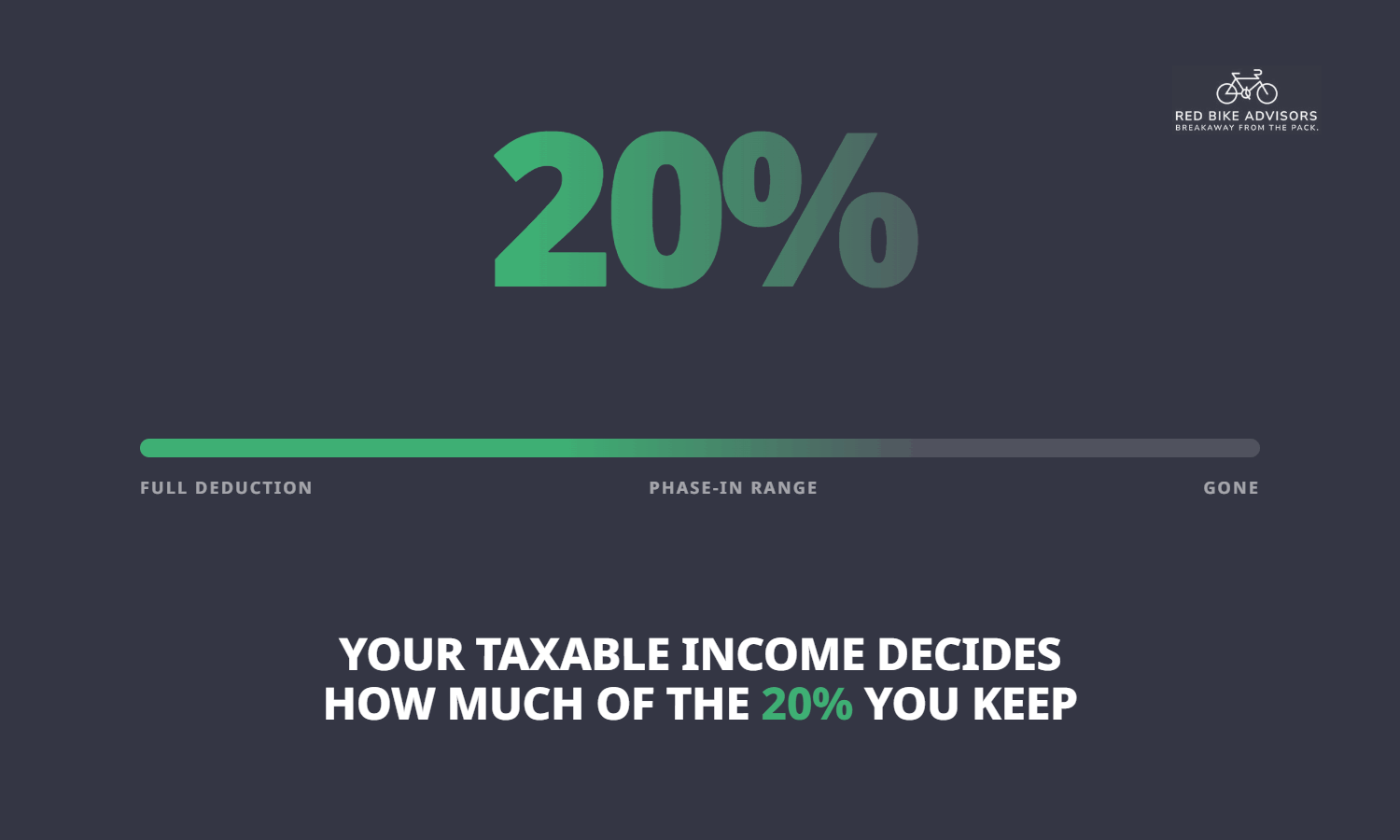
For 2026, you can take the full deduction if your taxable income is at or below $403,500 (married filing jointly) or $201,750 (single). Above those amounts, the deduction phases out over the next $150,000 (joint) or $75,000 (single). At $553,500 joint or $276,750 single, it's gone entirely (Rev. Proc. 2025-32).
An HVAC company isn't an SSTB, so its owner keeps the deduction at higher incomes, subject to other limits.
Which healthcare practices count as a specified service?
The regulations list health services performed by physicians, pharmacists, nurses, dentists, veterinarians, physical therapists, psychologists, and other similar healthcare professionals.
If you own a dental, medical, chiropractic, optometry, PT, veterinary, or behavioral health practice, assume you're in the SSTB group.
The One Big Beautiful Bill Act made the QBI deduction permanent and widened the phase-in range. That wider range is good news for healthcare owners, because it gives you more room to plan.
Why does the phase-in range matter so much?
Inside the phase-in range, every dollar of taxable income does two things. It gets taxed. And it shrinks your QBI deduction.
That means every dollar of deduction inside the range works twice. It lowers your taxable income directly, and it restores part of the QBI deduction you were losing.
Here's how that plays out for a practice owner filing jointly, simplified:
- Qualified business income from the practice: $300,000
- Projected taxable income: $480,000
- That's $76,500 into the $150,000 phase-in range, so you keep about 49% of your QBI deduction
- QBI deduction: 20% x 49% x $300,000 = about $29,400
Now add $60,000 in retirement plan contributions that fit your long-term plan anyway.
- New taxable income: $420,000, only $16,500 into the range
- You now keep about 89% of your QBI deduction
- QBI deduction: 20% x 89% x $300,000 = about $53,400
The $60,000 contribution reduces taxable income directly. It also brings back about $24,000 of QBI deduction you were losing. In a 32% bracket, that second piece is worth roughly $7,700 on its own.
(Real returns have more moving parts, including W-2 wage limits for owners above the threshold. )
Does your S-Corp salary affect your QBI deduction?
It does. Only the profit that flows through to you on your K-1 counts as qualified business income. The salary you pay yourself from an S-Corp stays out of it.
So salary and QBI pull in opposite directions. A higher salary shrinks QBI, and a lower salary grows it.
Above the threshold, it gets more tangled, because the deduction can also be limited by the W-2 wages your practice pays. That's one more reason to set your salary with the full picture in front of you, including the QBI effect, before your last payroll runs of the year.
What moves can bring your taxable income into a better spot?
If your projection puts you inside or just above the range, these are the usual levers:
- Retirement contributions sized to your cash flow and long-term plan
- A pass-through entity tax election in states that offer one
- Timing of equipment and other legitimate expenses you were planning to make anyway
- Charitable giving, including bunching several years of gifts into one year
Each one has its own rules and deadlines. Most of them have to be done by December 31.
What if your income is well above the range?
If your taxable income is $900,000, trimming $50,000 won't bring the QBI deduction back.
The math just isn't close.
That's useful to know too. It means your planning dollars belong in other strategies, and you can stop chasing a deduction you aren't going to get.
For many high earners in that position, the bigger wins come from retirement plan design, owner compensation structure, or cost segregation on a building they own.
Inside the phase-in range, every deduction works twice. Outside it, you plan differently. Either way, you want to know which side you're on before December.
If you're not sure where your practice lands against the 2026 QBI thresholds, October is the month to find out. Book a free strategy session, and we'll run the projection with you: https://redbikeadvisors.com/book-a-free-strategy-session
Gretchen Roberts
Gretchen Roberts is CEO of Red Bike Advisors LLC. As a business owner herself, Gretchen has a deep understanding of the problems, questions, and financial pain points that business owners experience on a daily basis, and how strategic financial and tax planning is the key to "breakaway" business growth and success.