
How Do You Build a Healthcare Practice that is Not Completely Dependent on the Owner

By Gretchen Roberts
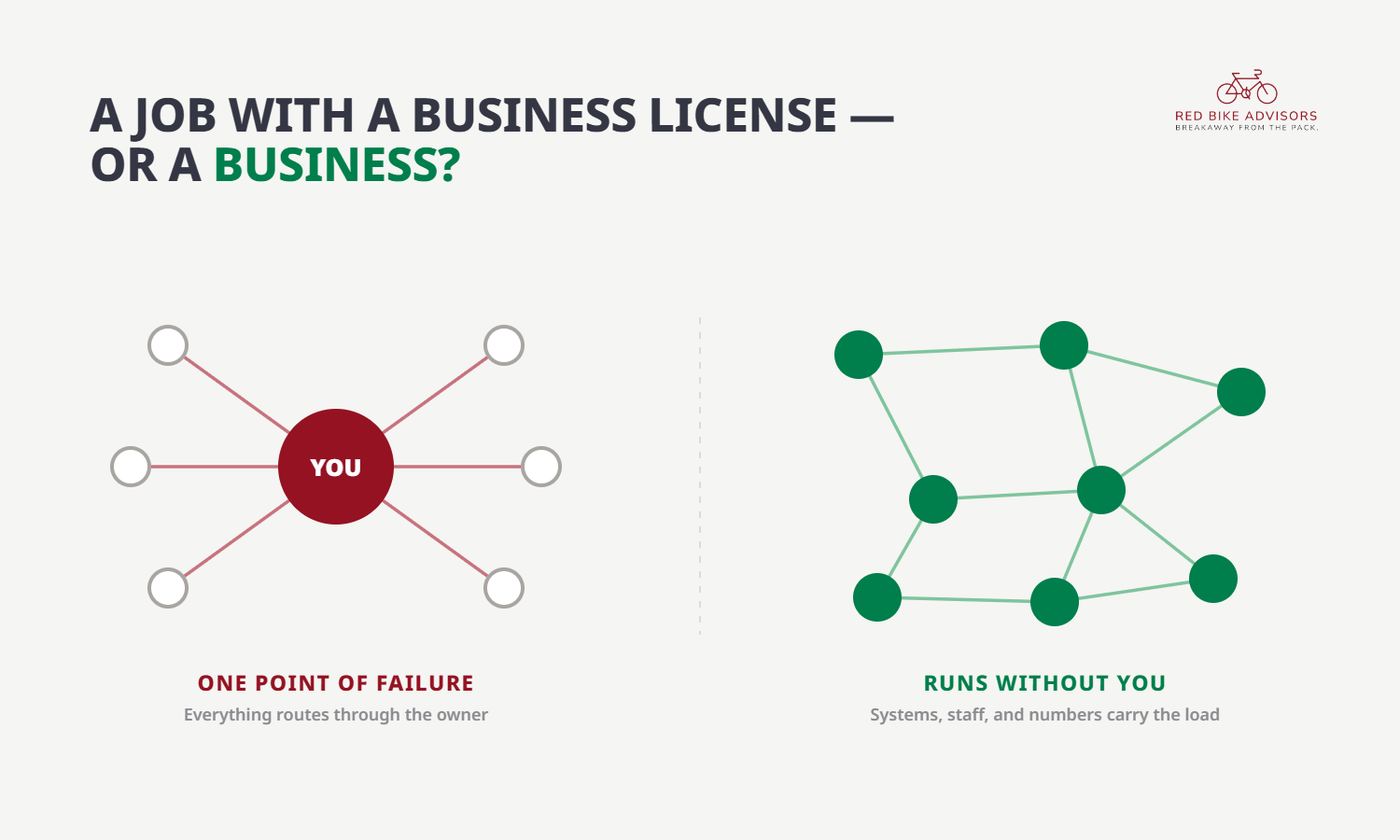
Owner dependency is the single most common value-destroyer in healthcare practice sales, and it is also the most overlooked source of daily operational stress. When a practice cannot function effectively without the owner in the building, it is not a business. It is a job that happens to have a business license attached. Building a practice that runs with reduced owner dependency makes it more profitable today, more saleable in the future, and significantly less stressful to operate in the years between. Here is how to think about it and what it actually requires.
Why does owner dependency hurt practice value?
When a buyer evaluates a healthcare practice, one of the first questions is: how much of this revenue goes away if the seller leaves?
A practice where 70% of revenue comes from the owner's personal clinical production is a high-risk acquisition. The buyer is not just buying a practice. They are buying the owner's patient relationships, referral sources, and clinical reputation. If those do not transfer reliably, the practice is worth significantly less than its revenue suggests.
The benchmark: Practices where no single provider generates more than 40% to 50% of total revenue are generally considered more saleable and command higher EBITDA multiples. In some specialties, buyers specifically discount practices where owner production exceeds 60% of revenue.
What does owner dependency actually look like?
Owner dependency is not just about clinical production. It shows up in several forms:
- Clinical dependency: The owner is the primary or only treating provider. Patient relationships are personal. Patients leave or reschedule when the owner is unavailable.
- Operational dependency: The owner makes most day-to-day decisions. Staff escalate everything. The practice stalls when the owner is out.
- Relationship dependency: Key referral sources are personal relationships of the owner. The owner handles all COI (center of influence) relationships personally.
- Financial visibility dependency: The owner is the only person who understands the practice finances. No one else can read the reports, identify trends, or manage to the numbers.
What is the Profit Time Index and why does it matter?
The Profit Time Index (PTI) measures how much profit the practice generates per hour of owner time invested. At Red Bike Advisors, we calculate this as annual profit before owner salary divided by total owner hours worked in the practice.
Benchmark targets: A PTI below $250 suggests the owner is working too hard relative to what the practice produces. A PTI of $500 to $1,000 indicates the practice is generating meaningful leverage. A PTI above $1,000 suggests the owner has built something that works without requiring every hour of their time.
Improving PTI does not require reducing clinical work immediately. It requires building systems, delegating decisions, developing clinical staff, and creating financial transparency that allows others to manage to the numbers.
What are the practical steps to reduce owner dependency?
Step 1: Hire to your clinical capacity, not your current need. If you are at 85% to 90% scheduling capacity as the sole clinical provider, adding an associate or partner before you are at 100% allows you to build a two-provider culture before necessity forces it.
Step 2: Build financial transparency at every level of the team. When your office manager can read a P&L and identify whether overhead is on track, operational dependency drops. Financial literacy for key staff is a leverage multiplier.
Step 3: Document the systems that currently live in your head. Referral relationships, patient communication protocols, insurance processes, and clinical workflows should be documented so they survive your absence. This is what buyers call a systems-driven practice.
Step 4: Make the financial model visible. Practices with clean books, monthly financial reviews, and staff who understand the KPIs are easier to operate without the owner and easier to sell. Financial clarity is not just a reporting function. It is an operational lever.
What does a systems-driven practice look like in practice?
It looks like a practice that runs at 95% of normal efficiency during a two-week owner vacation. It looks like staff who make decisions within clear authority levels without escalating everything. It looks like monthly financial reports that the team reviews together. It looks like referral relationships that are relationship-managed at multiple levels, not only by the owner.
That practice is worth more to a buyer. It is also more enjoyable to run.
A free strategy session is the right place to start a conversation about where your practice sits on the owner-dependency spectrum: https://redbikeadvisors.com/book-a-free-strategy-session/
Gretchen Roberts
Gretchen Roberts is CEO of Red Bike Advisors LLC. As a business owner herself, Gretchen has a deep understanding of the problems, questions, and financial pain points that business owners experience on a daily basis, and how strategic financial and tax planning is the key to "breakaway" business growth and success.