
How Much Should a Chiropractor Pay Themselves From Their Practice?

By Gretchen Roberts
Chiropractor owner compensation is not just a personal finance question. It is a tax planning question with real dollar consequences every year. The right answer depends on your practice structure, your revenue, your clinical workload, and how your compensation is categorized between salary and distributions. Most chiropractic practice owners have never had a formal compensation analysis done, which means they are likely paying more in taxes than they need to, or they are undervaluing their own contribution to the practice.
What is reasonable compensation for a chiropractor who owns their practice?
Benchmark starting point:
The IRS requires S-Corp owner-employees to pay themselves a“reasonable salary”for the services they perform. Reasonable compensation is not a number you choose for convenience. It reflects what a similarly qualified chiropractor would earn as an employed clinician in an arm's-length arrangement.
Factors the IRS and courts have considered in chiropractic compensation cases include:
- Regional market rates for employed chiropractors in your area
- Your actual hours in clinical care versus administrative or ownership functions
- The revenue the practice generates from your direct clinical production
- Comparable compensation from industry surveys
How does the salary versus distribution split affect your taxes?
If your chiropractic practice is structured as an S-Corp , profit above your reasonable salary can be taken as a distribution. Distributions are not subject to Social Security and Medicare taxes, which run at a combined 15.3% up to the wage base ($168,600 in 2024, source: IRS).
The math on this is direct. A chiropractor taking $240,000 per year as all salary pays payroll taxes on the full amount. The same chiropractor taking $110,000 as salary and $130,000 as a distribution pays payroll taxes only on the salary portion. The difference: roughly $19,890 per year in reduced payroll tax exposure, assuming the salary is defensible.
That $19,890 is not a loophole. It is the structure Congress intended when it created S-Corps. The requirement is that the salary portion must be reasonable and documented.
What is the most common compensation mistake chiropractors make?
Two mistakes show up consistently, and they tend to favor opposite extremes.
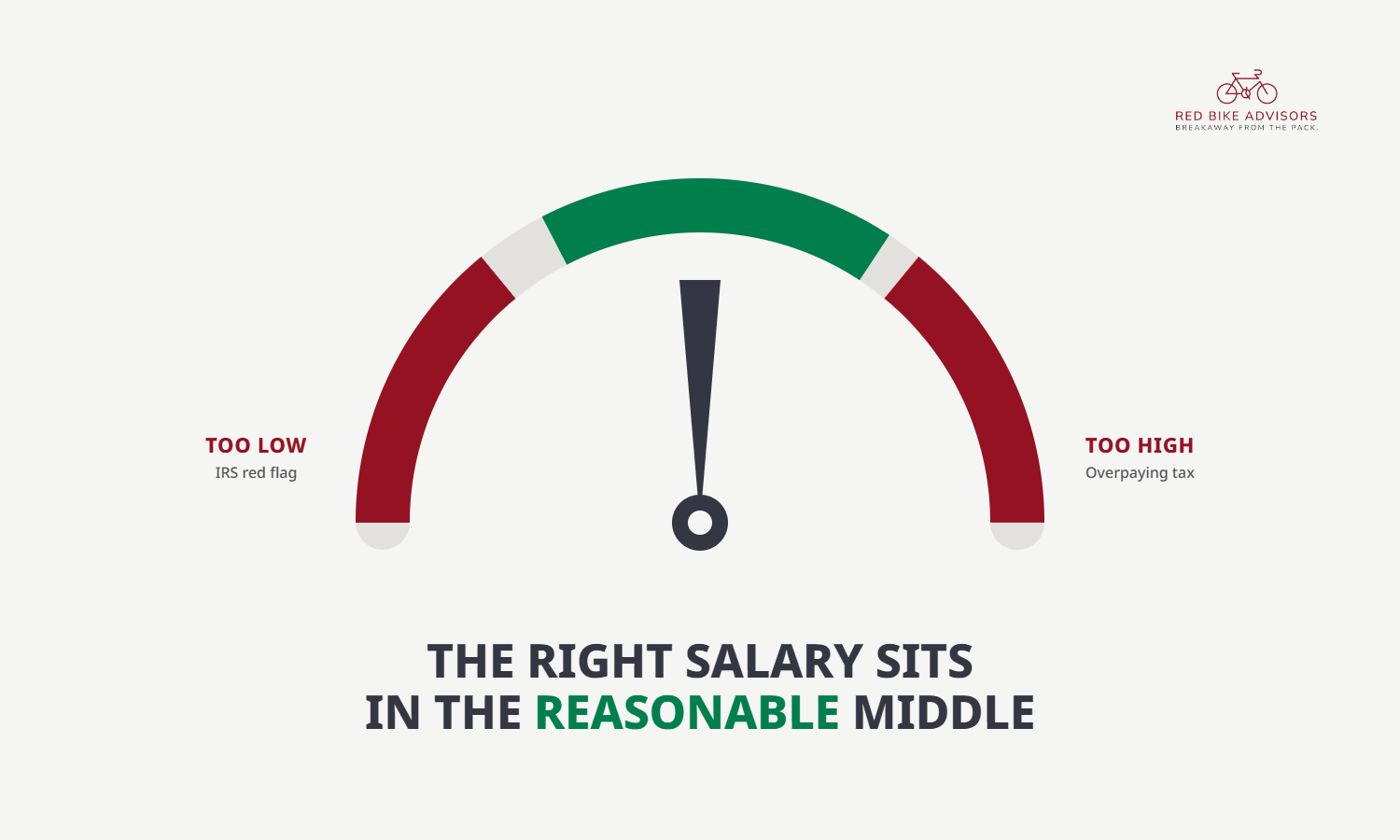
Mistake 1: The salary is too low. Setting salary at $40,000 on a $700,000 practice is a red flag the IRS actively looks for. Underpaid S-Corp owners who take most compensation as distributions get reclassified, and the back payroll taxes, penalties, and interest add up quickly.
Mistake 2: The salary was set years ago and never reviewed. A chiropractor who set their W-2 at $90,000 when the practice was at $500,000 and now runs a $1.2M practice may be significantly overpaying in payroll taxes. The salary should reflect current role and current revenue.
The right answer sits between these two extremes and changes as the practice evolves. An annual review is not optional. It is good tax hygiene.
How does owner compensation interact with retirement plan contributions?
This is where the strategy gets interesting. Your W-2 compensation is the basis for retirement plan contribution limits.
A chiropractor with a Solo 401(k) can contribute up to $23,000 as an employee deferral in 2024, plus up to 25% of W-2 compensation as an employer contribution (source: IRS Publication 560). A $110,000 W-2 salary supports a combined contribution of up to $50,500 per year, generating significant current-year tax deductions.
A defined benefit plan can potentially allow even larger contributions, sometimes exceeding $100,000 annually depending on age and salary. These plans require actuarial calculation and must be established before year-end. They are most effective for practice owners in their 40s and 50s who want to accelerate tax-advantaged retirement savings.
What does a well-structured chiropractor compensation plan look like?
A well-structured plan does four things:
- Sets a defensible W-2 salary supported by market data and documented annually
- Takes additional practice profit as distributions to reduce payroll tax exposure
- Coordinates the salary level with retirement plan contribution strategies
- Reviews the structure every year as practice revenue and the owner's clinical role evolve
This is not a complex structure. It is a consistent, documented, annually reviewed one. Most chiropractors have never had the conversation.
Download the Chiropractic KPI Benchmark Guide and book a free strategy session to review your compensation structure: https://redbikeadvisors.com/book-a-free-strategy-session/
Gretchen Roberts
Gretchen Roberts is CEO of Red Bike Advisors LLC. As a business owner herself, Gretchen has a deep understanding of the problems, questions, and financial pain points that business owners experience on a daily basis, and how strategic financial and tax planning is the key to "breakaway" business growth and success.