
How to Start Building Personal Wealth From Your Healthcare Practice (Without Waiting Until Exit)

By Gretchen Roberts
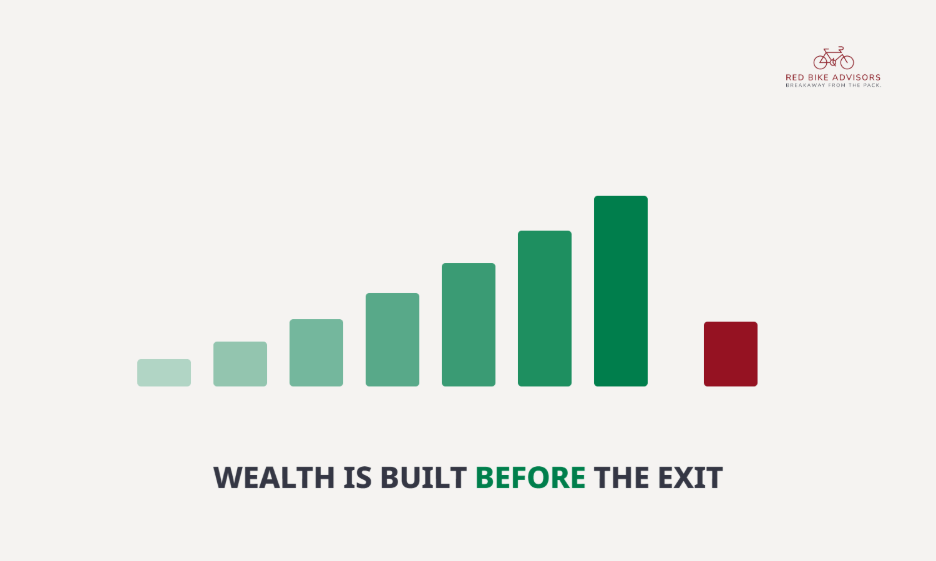
How do healthcare practice owners build personal wealth while still running their practice?
Most healthcare practice owners treat personal wealth building as something that happens after a practice sale. It is not. The most financially successful practice owners build personal wealth continuously while the practice is running, using the practice's income to fund tax-advantaged retirement accounts, structured investment programs, and real estate, often decades before any exit. The practice sale becomes a capstone, not a starting point. Here is how to start building personal wealth from your practice today.
What is the first step toward building wealth from a healthcare practice?
The first step is getting the practice's own financial house in order. A practice that generates $1.5M in revenue but operates without a proactive tax plan, without benchmarked overhead, and without a clear compensation structure is almost certainly leaving $40,000 to $100,000 or more per year on the table. That is the capital base for personal wealth building that is evaporating before the owner can deploy it.
Proactive tax planning, owner compensation optimization, and overhead benchmarking are not just operational improvements. They are wealth-building prerequisites. Every dollar recovered through these processes is a dollar available for investment.
How do tax-advantaged retirement plans create wealth for practice owners?
Retirement plans are the single most accessible and highest-leverage wealth-building tool available to a self-employed healthcare practice owner. Here is what the contribution limits look like in 2026 (source: IRS Notice 2025-67):
- Solo 401(k): up to $72,000 for those 50 and older (including catch-up contributions)
- SEP-IRA: up to 25% of compensation, maximum $72,000
- Defined benefit plan: contributions can exceed $150,000 to $200,000 annually depending on age and compensation, with actuarial calculation required
- Health Savings Account: $8,750 for family coverage in 2026, triple tax-advantaged
A practice owner in their early 50s who funds a defined benefit plan and a 401(k) simultaneously can contribute $200,000 or more per year in tax-deductible retirement savings. At a 35% effective tax rate, that is $70,000 in annual tax savings while building a compounding asset base. Over 10 years, that compounding can represent $3M to $5M in retirement wealth depending on investment returns.
What is the role of the practice in a broader personal wealth strategy?
The practice itself is an asset. But it is a concentrated, illiquid, owner-dependent asset. Relying on the practice sale as the primary retirement funding mechanism creates significant risk: the market for practices changes, health events are unpredictable, and valuations can compress.
The practice owners who achieve genuine financial independence use the practice income to fund diversified, liquid assets outside the practice: retirement accounts, real estate, and investment portfolios. By the time they consider an exit, they have significant financial independence that does not depend on the sale price.
How does owner compensation structure affect wealth building?
How you pay yourself as a practice owner directly affects how much you can contribute to retirement plans, how much you pay in payroll taxes, and how much capital is available for investment.
An S-Corp owner with a properly structured salary and distribution split avoids self-employment tax on the distribution portion. That avoided tax is real capital. Combined with a retirement plan funded to the maximum defensible contribution, the tax-efficient compensation structure compounds into significantly more personal wealth over time than a default, unreviewed compensation arrangement.
The wealth-building calendar that practice owners should follow
By January: Confirm retirement plan contribution for the prior year and set the current year contribution schedule.
By March: Review owner compensation structure and model the optimal salary-to-distribution split for the current year.
By July: Mid-year tax projection updated. Confirm retirement plan contributions are on track. Evaluate any additional wealth-building moves.
By October: Year-end planning session. Confirm all retirement contributions will be funded before December 31. Evaluate defined benefit plan or additional retirement strategy if income is higher than projected.
A free strategy session is the right place to start a conversation about building personal wealth from your practice: https://redbikeadvisors.com/book-a-free-strategy-session.
Gretchen Roberts
Gretchen Roberts is CEO of Red Bike Advisors LLC. As a business owner herself, Gretchen has a deep understanding of the problems, questions, and financial pain points that business owners experience on a daily basis, and how strategic financial and tax planning is the key to "breakaway" business growth and success.