
Should a Chiropractic Practice be an S-Corp or an LLC?

By Gretchen Roberts
For most chiropractic practice owners generating $150,000 or more in annual net profit, the S-Corp election produces payroll tax savings that a default single-member LLC does not. The S-Corp is not a separate legal entity from an LLC. It is a tax election that changes how your profit is categorized for IRS purposes. Here is the specific math for chiropractic practices, the state-level considerations that matter, and the mistakes to avoid when making the switch.
How does an S-Corp election save a chiropractor money on taxes?
Under a default single-member LLC, all net profit is subject to self-employment tax at 15.3% up to $168,600 (the 2024 Social Security wage base, source: IRS), and 2.9% above that. When you elect S-Corp tax treatment, you pay yourself a reasonable salary subject to payroll taxes, and remaining profit above that salary is distributed without self-employment tax.
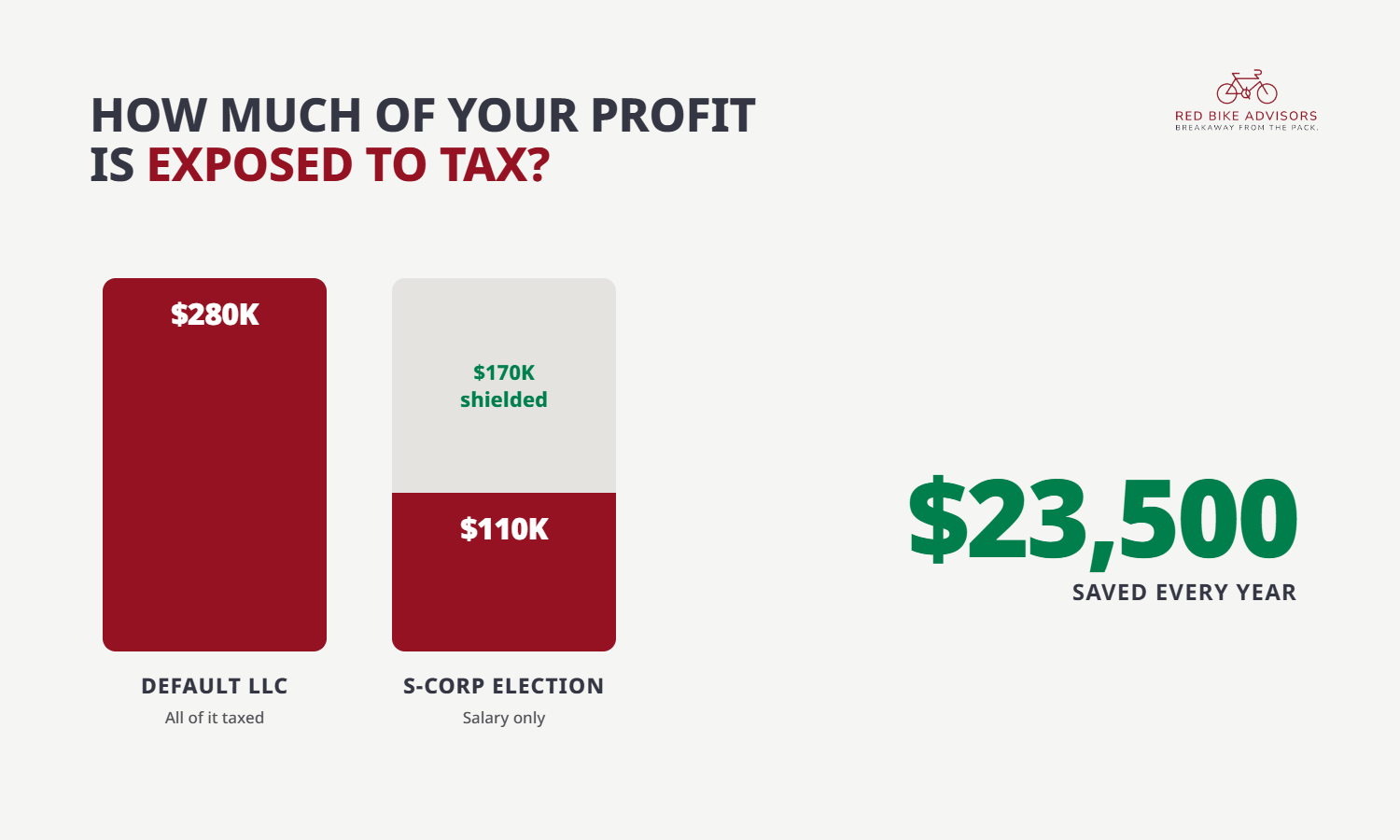
A practical example: a chiropractor with a solo practice generates $280,000 in net profit. Under a default LLC, she pays self-employment tax on $280,000. With an S-Corp election and a $110,000 defensible salary, she pays payroll taxes on $110,000 only. The $170,000 taken as S-Corp profit avoids self-employment tax. Annual payroll tax savings at 15.3%: approximately $26,010. After estimated $2,500 in additional administrative costs, net savings: roughly $23,500 per year.
What is a reasonable salary for a chiropractic practice owner?
This is the question that determines whether the S-Corp election works or creates IRS risk.
Reasonable compensation for a working owner-chiropractor typically ranges from $80,000 to $150,000 depending on:
- Regional market rates for employed DCs in your area
- Hours you spend in direct patient care versus administrative or ownership functions
- Your production relative to the total practice revenue
- Industry surveys and comparable compensation data
The IRS does not provide a specific number, but it looks for S-Corp owners who are paying themselves materially below what they would pay an arm's-length employee to do the same work. A $45,000 salary on a $600,000 chiropractic practice is a red flag. A $100,000 salary on the same practice, supported by market data and documented annually, is defensible.
Do chiropractic practices face any special entity structure rules?
Yes, and the rules vary by state. Many states require chiropractic practices to be organized as a professional corporation (PC) or professional limited liability company (PLLC) owned only by licensed chiropractors. Standard LLCs cannot practice chiropractic in those states.
A professional corporation can make the S-Corp tax election just as a standard corporation can. The legal entity is a PC; the tax election makes it an S-Corp. Before making any structural change, confirm that the entity type you are moving to is legally permissible for chiropractic practice in your state.
When does the S-Corp election not make sense for a chiropractor?
When net profit is below $100,000 to $150,000 above salary. The payroll tax savings at that profit level may not justify the annual administrative overhead of running payroll and filing a separate S-Corp return.
When the practice is still in startup mode. S-Corp elections are best made once the practice has a stable, predictable income that makes a defensible salary determination straightforward.
When state law restrictions create complications. In some states, the professional corporation requirements add legal costs that narrow the net benefit. The calculation needs to include all-in costs, not just the federal payroll tax savings.
What is the most common mistake when switching from LLC to S-Corp?
The most common mistake is making the election without a formal compensation analysis. Setting the salary too low invites IRS scrutiny. Setting it too high eliminates the tax savings. And setting it once without reviewing it annually as the practice grows means the structure may drift out of alignment with what is defensible.
An S-Corp election is not a set-it-and-forget-it decision. It is an annual conversation that should happen every year with your advisory team as practice revenue evolves.
A free strategy session is the right place to model the S-Corp election for your specific practice and run the actual numbers: https://redbikeadvisors.com/book-a-free-strategy-session/.
Gretchen Roberts
Gretchen Roberts is CEO of Red Bike Advisors LLC. As a business owner herself, Gretchen has a deep understanding of the problems, questions, and financial pain points that business owners experience on a daily basis, and how strategic financial and tax planning is the key to "breakaway" business growth and success.