
What Are the 5 Signs a Healthcare Practice Is in Stabilization Mode?

By Gretchen Roberts
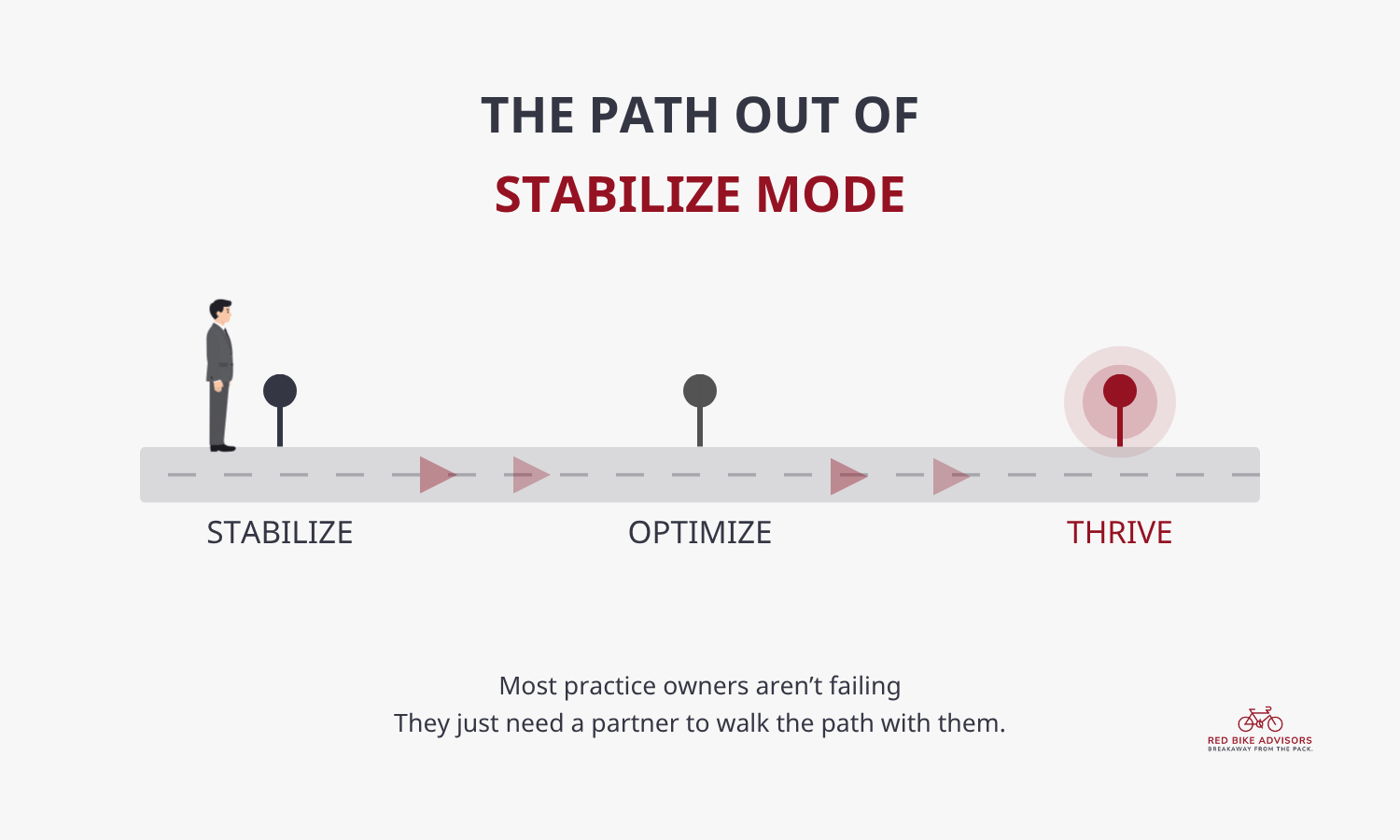
A healthcare practice in Stabilize mode is financially functional but not financially clear.
The books may be getting done, but real-time visibility is missing. Tax season is still a scramble. Cash feels tight even when revenue is up. Decisions get made on gut feel instead of clean numbers. Stabilize mode is not a crisis, but it is expensive. Practices that identify it early get out of it faster, with less damage, and with a clear path to the next stage.
The five signs are: you don't know your numbers without asking someone first, tax season is a scramble every year, you're profitable on paper but confused about cash, you haven't had a strategic conversation with your accountant in over a year, and you're making big financial decisions without a financial framework.
What does it mean to not know your numbers as a practice owner?
If someone asked you right now what your overhead percentage is, could you answer?
What about revenue per patient visit? Net profit margin last quarter?
If the honest answer is "I have no idea," your financial reporting is not serving you. A practice in Stabilize mode often has books that are behind, inconsistent, or formatted in a way that doesn't connect to actual decisions. The monthly close is late or nonexistent. The P&L is a document that gets filed away rather than acted on.
You cannot improve numbers you are not looking at.
Why tax season feels like a scramble every year for practice owners
For practices in Stabilize mode, tax season means a frantic search for receipts, calls from the accountant asking for documents you can't find, and a final bill that feels like a surprise, no matter what.
This is not a tax problem. It is a systems problem.
When books are clean and updated monthly, tax preparation is straightforward. Your advisory firm already has everything they need. There is no scramble. There are no surprises. The return is simply documentation of a year that was already well-managed. If you are still doing the document sprint every February and March, that is a sign your financial foundation needs attention.
What does it mean when a practice is profitable on paper but cash feels tight?
One of the most disorienting experiences in practice ownership is this: your accountant says you had a profitable year, but you look at your bank account, and something does not add up.
This is not uncommon. And it is not magic. It is a cash flow visibility problem.
Profit and cash are not the same thing. Profit is an accounting concept. Cash is what pays your staff on Friday. Practices in Stabilize mode often have no cash flow cushion or forecast. No visibility into what is coming in, what is going out, and when. They manage by checking the bank balance and hoping it is enough. If this sounds familiar, it starts with clean monthly reporting that separates profit from cash movement.
How often should a healthcare practice owner talk to their accountant about strategy?
Here is a simple diagnostic.
When was the last time your accountant called you, not to ask for documents, but to share an insight about your practice finances? To flag a planning opportunity? To ask how the practice was growing and whether your current structure still made sense?
If the answer is never, you are in Stabilize mode by default. A year-round strategic partner and a seasonal tax preparer are fundamentally different relationships. One is reactive. One is proactive. Most practices default to reactive because that is what was available when they first needed help. But reactive accounting is one of the most expensive habits a growing practice can have.
What does it look like when a practice owner makes big financial decisions without a framework?
Should you hire another associate? Expand your space? Upgrade equipment? Buy the building?
These are significant financial decisions. In Stabilize mode, they often get made based on gut feel, or on what other practice owners seem to be doing, or on a conversation with a vendor who has an obvious incentive.
What they rarely get made from: clean financials, a cash flow projection, a tax impact analysis, and a clear picture of what the decision means for practice profitability over the next three to five years. I talked with a physical therapy practice owner last quarter who was considering opening a second location. The idea made sense on paper. But when we ran the numbers, the first location's overhead was running at 74 percent. Opening a second location on a 74 percent overhead base does not expand profitability. It multiplies the problem. She paused the expansion, fixed the overhead structure first, and is now in a much stronger position to grow.
How does a healthcare practice move from Stabilize to Optimize?
Stabilize mode is not a permanent condition. But it does not fix itself.
The path forward starts with three things: clean, current books with a monthly close every month; a financial report you actually understand, with benchmarks relevant to your practice type; and a proactive conversation at least quarterly that covers what is happening, what is coming, and what moves make sense now.
That is the foundation of the Optimize stage. And it is where most practices unlock the financial clarity they have been missing.
The practices that grow without the financial chaos were not lucky. They had the right systems and the right partner in place.
Wondering where your practice stands?
We offer a free strategy session for healthcare practice owners who want an honest read on their current financial situation and a clear picture of what comes next.
Book your free strategy session here redbikeadvisors.com/book-a-free-strategy-session/
Gretchen Roberts
Gretchen Roberts is CEO of Red Bike Advisors LLC. As a business owner herself, Gretchen has a deep understanding of the problems, questions, and financial pain points that business owners experience on a daily basis, and how strategic financial and tax planning is the key to "breakaway" business growth and success.