
What Are the Most Common Financial Blind Spots in a Chiropractic Practice?

By Gretchen Roberts
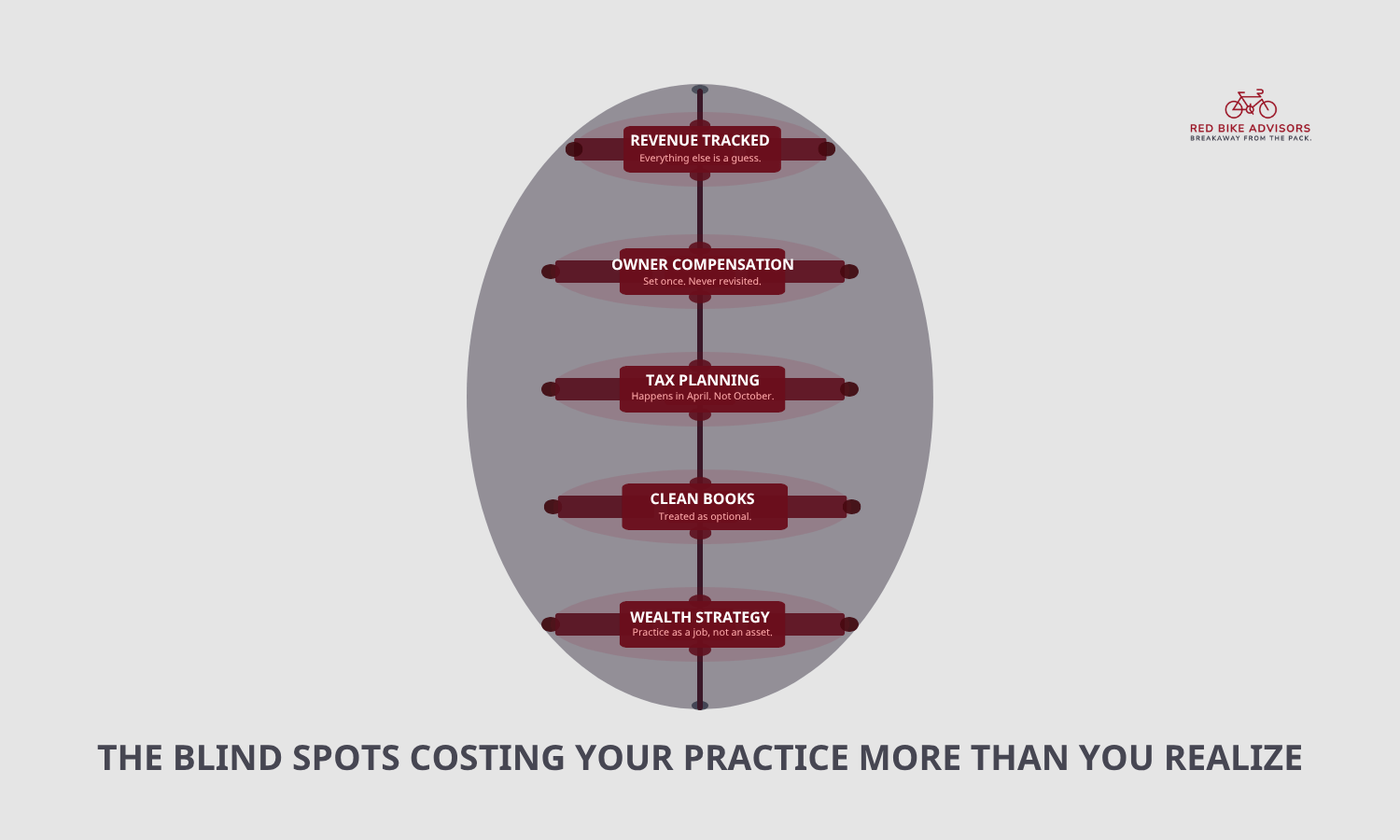
The most common financial blind spots in a chiropractic practice are: revenue per visit has never been calculated, collections ratio is leaking money silently, staff and overhead costs have never been benchmarked by category, tax planning happens in April instead of October, and the practice is not managed as a wealth-building asset. Most chiropractors I talk to are excellent clinicians. They have built something real. But when the conversation turns to practice finances, this same pattern shows up almost every time. The numbers that actually drive profit go untracked until something feels wrong. And by then, the cost of not knowing has been compounding for years.
What is a good average revenue per visit for a chiropractic practice?
This is the one number most chiropractors have never calculated. And it is the most powerful financial lever unique to chiropractic.
Average revenue per visit reflects your billing model, your fee schedule, and your service mix. It determines your revenue ceiling regardless of how full your schedule is.
The benchmarks vary by billing model. Cash-pay practices should be at $120 to $200 or more per visit, with top performers hitting $180 to $250 or above. Insurance-based practices typically run $60 to $90 per visit, with top performers at $85 to $100. Mixed model practices fall between $85 and $130, with top performers at $120 to $160.
The difference between $75 per visit and $110 per visit at 6,000 annual visits is $210,000 in revenue. Not from working harder. Not from seeing more patients. From getting paid appropriately for the care you are already delivering.
If you have never calculated this number, that is the place to start.
What collections ratio should a chiropractic practice be hitting?
Your collections ratio is the most direct indicator of billing efficiency. And it is one of the quietest profit leaks in the practice.
The benchmark is 95% or above. Top performers collect 97% to 99%.
Every point below 95% represents money you earned but never received. Lost to claim denials, write-offs, or billing gaps that no one is watching closely enough.
Improving your collections ratio from 90% to 95% on $800,000 in billing generates $40,000 in additional revenue annually. That is without adding a single patient or working a single additional hour. It is money already on your schedule. Just not in your bank account.
What percentage of revenue should staff costs be in a chiropractic practice?
Chiropractic has a leaner staffing model than most healthcare specialties. Which means there is less excuse for staff costs that have crept above benchmark without anyone noticing.
The target is 18% to 28% of revenue. Top performers run under 22%. I recently reviewed financials with a chiropractic practice owner who had never seen his costs broken out by category. His staff costs were running at 36% of revenue. He had no idea. He thought he had a revenue problem. He had a cost structure problem.
Every point above 28% costs an $800,000 practice approximately $8,000 in net profit. A practice running at 32% staff cost instead of 24% is leaving $64,000 on the table annually.
The fix is rarely about cutting people. It is about right-sizing roles, cross-training, and building scheduling systems that reduce idle hours.
Once we identified the specific lines driving the overrun, the path forward was clear. The revenue was fine. The allocation was not.
What is a healthy overhead percentage for a chiropractic practice?
Overhead is where chiropractic profit quietly disappears.
The industry average is around 50% of revenue, according to zHealth's 2025 benchmarking data. Top performers hold overhead under 44%. Rent alone should be 6% to 9% of revenue. When it creeps above that, or when software, marketing, and admin costs stack without review, the margin compresses fast.
On an $800,000 practice, the difference between 50% overhead and 42% overhead is $64,000 in additional net profit annually.
The practices that hold overhead under 44% are not cutting corners. They renegotiate leases at renewal, audit software subscriptions quarterly, and treat every overhead dollar as a direct reduction in what they take home.
What net profit margin should a chiropractic practice owner expect?
Net profit margin is the clearest measure of what your practice actually produces for you.
And chiropractic has a leaner overhead structure than most healthcare specialties, which means there is more room here than most owners realize.
A healthy net profit margin is 30% to 40% of revenue. Top performers run 40% to 55%.
A practice at $800,000 in revenue running at 20% net margin keeps $160,000. The same practice at 35% margin keeps $280,000. That is $120,000 more per year with the same patients, the same building, and the same hours.
The gap between average and top performer in chiropractic is almost never about revenue.
It is about margin discipline.
What is Patient Visit Average and why does it matter financially?
Patient Visit Average, or PVA, is the chiropractic-specific metric that determines lifetime value per patient. It is the average number of visits a new patient completes per care plan.
The benchmark is 35 to 50 visits. Top performers average 40 or more.
A low PVA means you are completing exams, building trust, and then losing patients before they finish care. That is both a clinical and a financial loss.
A practice with a PVA of 15 versus a practice with a PVA of 35 is generating less than half the lifetime value per new patient. At $95 per visit, that is $1,425 versus $3,325 per patient.
If you bring in 20 new patients per month, that PVA gap alone is worth $460,000 in annual revenue from the same marketing spend, the same new patient volume, and the same team.
When should a chiropractic practice owner be doing tax planning?
The single most expensive financial habit I see in chiropractic practices is reactive tax management.
Every meaningful tax-saving move: retirement plan elections, equipment decisions, compensation adjustments, entity structure reviews, needs to happen before December 31. By the time your accountant is reviewing your return in the spring, the window for most of those moves has already closed.
Practices that save the most on taxes are not doing anything exotic. They are just having the strategy conversation in October instead of April.
A few tools that chiropractic practice owners frequently underuse: Section 179 expensing for equipment and technology, Solo 401(k) or SEP-IRA contributions that meaningfully reduce taxable income, and a documented reasonable salary analysis that both protects you from IRS scrutiny and minimizes what you owe.
Tax season is not when tax strategy happens. It is when last year's strategy gets documented.
What does it mean for a chiropractic practice owner to manage the practice as a wealth-building asset?
Most chiropractors think of their practice as a job. A great job, one they built themselves, but still a job.
The most financially successful practice owners think of it differently. The practice is an asset. And its value is built over time through deliberate decisions about profitability, structure, and systems.
Here is the measure that makes this concrete: the Profit Time Index. Take your annual net profit and divide it by the hours you work in the practice each year. A healthy range is $150 to $300 per hour. Top performers are at $400 or above.
If your number is lower than what you could earn as an associate doctor, your ownership is costing you money, not making you money. That is not a hustle problem. It is a structural problem.
And for long-term exit value: buyers typically use a multiple of adjusted EBITDA. For a well-run chiropractic practice, that multiple commonly ranges from 2x to 4x. Every $50,000 improvement in annual profitability can add $100,000 to $200,000 to the eventual sale price.
The practices that grow profitably and eventually sell or transition on their own terms are not the ones with the highest revenue. They are the ones that treated the financial side of the practice as seriously as the clinical side.
How does a chiropractic practice owner start addressing these blind spots?
None of these are complicated to fix. But they do not fix themselves.
Start with the one that feels most familiar. For most chiropractic practice owners, it is either a number they have never calculated: revenue per visit, collections ratio, PVA or a system that has never been put in place, like monthly books or a proactive tax conversation before year-end.
Pick one. Get current. The clarity compounds from there.
If you know something feels off but don’t know exactly what. That is fine. That is what the conversation is for.
Book a free strategy session at redbikeadvisors.com/book-a-free-strategy-session
Gretchen Roberts
Gretchen Roberts is CEO of Red Bike Advisors LLC. As a business owner herself, Gretchen has a deep understanding of the problems, questions, and financial pain points that business owners experience on a daily basis, and how strategic financial and tax planning is the key to "breakaway" business growth and success.