
What is Section 179 and How Does it Apply to a Dental Practice?

By Gretchen Roberts
Section 179 of the IRS tax code allows dental practice owners to deduct the full purchase price of qualifying equipment and technology in the year it is placed in service, rather than depreciating the cost over five to seven years. For 2024, the Section 179 deduction limit is $1,160,000 (source: IRS Revenue Procedure 2023-34). This deduction can apply to dental chairs, digital X-ray equipment, CBCT scanners, intraoral cameras, CEREC milling units, practice management software, and qualifying facility improvements. Used strategically, Section 179 is one of the most accessible near-term tax reduction tools available to dental practice owners.
What equipment qualifies for Section 179 in a dental practice?
Most tangible business property placed in service during the tax year qualifies. In a dental context, this typically includes:
- Dental chairs and delivery units
- Digital radiography systems
- Cone beam computed tomography (CBCT) scanners
- Intraoral cameras and scanners
- Chairside milling systems (CEREC and similar)
- Sterilization equipment
- Practice management and imaging software
- Computer hardware and monitors used in the practice
- Qualifying leasehold improvements (with some restrictions)
The key requirement is that the property must be placed in service during the tax year in which you are claiming the deduction. Equipment ordered in December but not delivered and operational until January does not qualify for the prior year.
How much can a dental practice actually save with Section 179?
The savings depend on your effective tax rate and the amount of qualifying property purchased. A simple illustration:
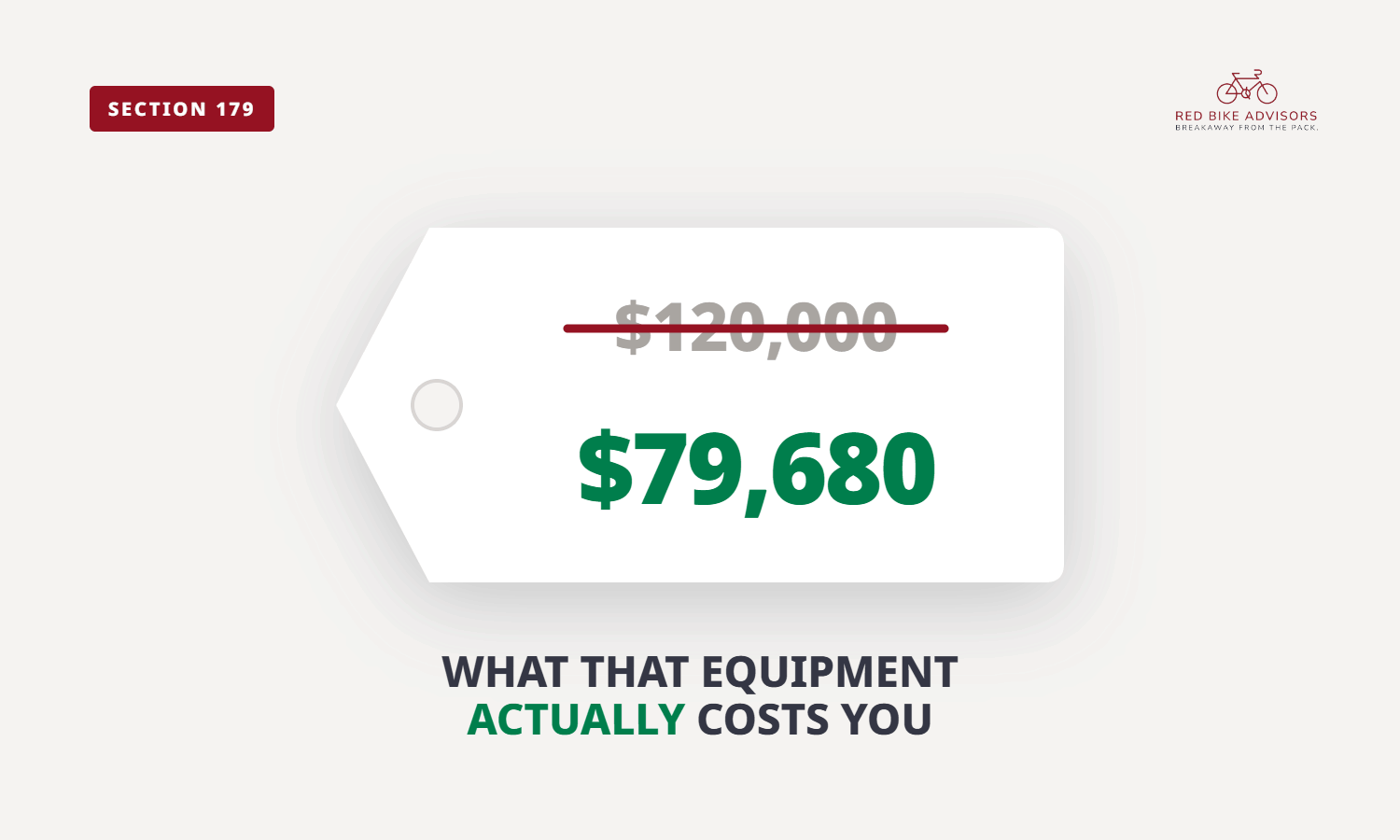
A dental practice owner in the 32% federal tax bracket purchases a CBCT scanner for $80,000 and a digital X-ray upgrade for $40,000, totaling $120,000 in qualifying equipment. Without Section 179, using standard five-year MACRS depreciation, the first-year deduction would be approximately $24,000 (20% in year one). With full Section 179 expensing, the entire $120,000 is deductible in year one.
The tax impact at 32% federal plus a hypothetical 5% state rate: the additional $96,000 in first-year deductions generates approximately $35,520 in federal tax savings and $4,800 in state savings, for a combined $40,320 reduction in year-one taxes. The net cost of that $120,000 in equipment, after tax savings, is approximately $79,680.
Note: These are illustrative figures. Your actual savings depend on your tax bracket, state rates, and how the equipment is financed. A qualified tax professional should calculate the impact for your specific situation.
When should a dental practice NOT use Section 179?
This is the part most articles skip, and it is the part that matters.
When you do not have the income to absorb it. Section 179 deductions are limited to your taxable income from active business. If your practice has a net loss or minimal profit, you cannot use Section 179 to generate a loss. The deduction carries forward, but the timing benefit is deferred.
When accelerating income in the next year makes more sense. If you expect significantly higher income next year, shifting the deduction forward by delaying the purchase into January may be more valuable than taking it now.
When it creates a planning problem for retirement contributions. Aggressively reducing taxable income with Section 179 can also reduce your ability to make deductible retirement contributions in some plan structures. The interaction between equipment deductions and retirement plan strategy needs to be modeled together, not in isolation.
When bonus depreciation achieves the same result. Bonus depreciation (100% in prior years, phasing down in 2024 and 2025) can sometimes accomplish the same first-year expensing goal. The choice between Section 179 and bonus depreciation has implications for which assets are covered and how carryforwards work.
When is the deadline for a Section 179 deduction?
The equipment must be placed in service before December 31 of the tax year you are claiming the deduction. This is an absolute deadline. Equipment delivered and functional on December 31 qualifies. Equipment delivered on January 1 does not, regardless of when you ordered or paid for it.
This deadline is why October and November are the months when proactive planning conversations about equipment purchases happen. By December, the decision is often already made by circumstance rather than strategy.
A free strategy session before year-end is the right place to model whether a Section 179 purchase makes sense for your practice this year.
Gretchen Roberts
Gretchen Roberts is CEO of Red Bike Advisors LLC. As a business owner herself, Gretchen has a deep understanding of the problems, questions, and financial pain points that business owners experience on a daily basis, and how strategic financial and tax planning is the key to "breakaway" business growth and success.