
What Is the Difference Between Reactive Tax Filing and Proactive Tax Strategy for a Healthcare Practice?

By Gretchen Roberts
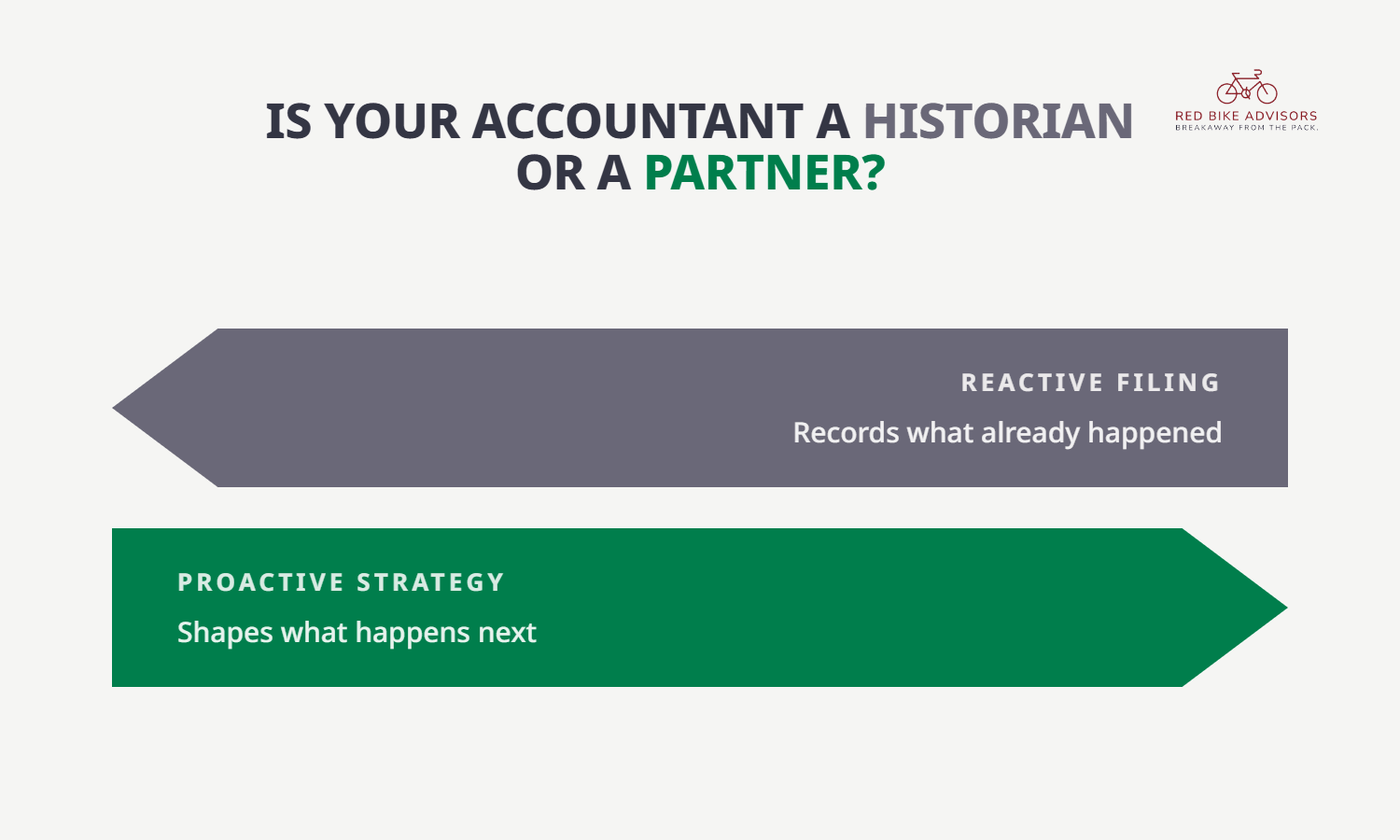
Reactive tax filing and proactive tax strategy both produce a tax return, but they can produce very different tax bills and very different relationships with your money. If you just survived another painful tax season, a surprise bill, or another year of silence from your accountant between March and March, this is the post that explains what the alternative looks like.
What Does Reactive Tax Filing Actually Look Like?
Your accounting firm contacts you in January or February with a document request. Documents go back and forth. Your return is completed in March or April. You find out what you owe. The number may be accurate. It reflects everything that happened last year. But it was not shaped. It was recorded.
By the time you see the number in April, the decisions that could have reduced your liability closed on December 31. In the reactive model, your accountant is a historian. They tell you what happened.
What Does Proactive Tax Strategy Actually Look Like?
Proactive strategy starts in January with a planning conversation, not a document request. It reviews your prior year and sets the financial agenda for the year ahead. In the fall, it runs a tax projection and executes year-end strategies before December 31. In April, the return reflects a year that was actively managed. The number is expected. It was planned. In the proactive model, your accountant is a partner. They help shape what happens before it becomes history.
Side-by-Side: What Does the Practice Owner Actually Experience?
| Reactive Filing | Proactive Strategy | |
|---|---|---|
| When does the relationship start? | February, for documents | January, for planning |
| Strategic conversations per year | One (if any) | Four or more |
| When is tax liability first discussed? | April, when final | January and fall |
| Year-end strategy? | Not applicable | Executed in Q4 |
| Surprise tax bill? | Common | Rare |
| Monthly financial reports? | Not included | Standard |
What Does a Real Switch Look Like?
I was talking with a dentist owner last spring who had been with a reactive firm for nine years.
Returns were filed. Everything was legally correct.
In year one with a proactive advisory relationship, three things changed:
- Retirement plan restructured from a SEP-IRA to a defined benefit plan, sheltering an additional $62,000 in taxable income.
- Owner compensation reviewed. Payroll tax savings: $14,000 per year recurring.
- Section 179 election on equipment already planned: deducted $80,000 in the year of purchase. The prior accountant had not done anything wrong. They had filed an accurate return. They had not done the proactive work. Because that is not what reactive filing includes.
How Much Does Proactive Strategy Cost More Than Reactive Filing?
Proactive advisory relationships cost more than once-a-year tax preparation. The question is not whether it costs more. The question is whether the ROI justifies the difference. A practice generating $1.5 million or more in revenue that has never had a proactive advisory relationship almost always has $20,000 to $60,000 or more in annual tax savings available. The cost of proactive advisory services is typically a fraction of the savings they produce.
Is Proactive Tax Strategy Right for Every Practice?
Not every practice is the right fit. If your practice is generating under $500,000 in revenue and your financial situation is straightforward, tax preparation may genuinely be what you need. If your practice is generating $1 million or more, has complex entity structure, has owner compensation that has never been reviewed, or has a tax bill that feels larger than expected year after year, proactive strategy is almost certainly worth the conversation. A free strategy session is the only way to know for certain. We look at your actual situation, tell you what we see, and let you decide whether the relationship makes sense.
A free strategy session is the only way to know for certain. We look at your actual situation, tell you what we see, and let you decide whether the relationship makes sense. Book it here: https://redbikeadvisors.com/book-a-free-strategy-session
Gretchen Roberts
Gretchen Roberts is CEO of Red Bike Advisors LLC. As a business owner herself, Gretchen has a deep understanding of the problems, questions, and financial pain points that business owners experience on a daily basis, and how strategic financial and tax planning is the key to "breakaway" business growth and success.