
What Is the Pass-Through Entity Tax Election, and Should Your Chiropractic Practice Make It Before Year-End?

By Gretchen Roberts
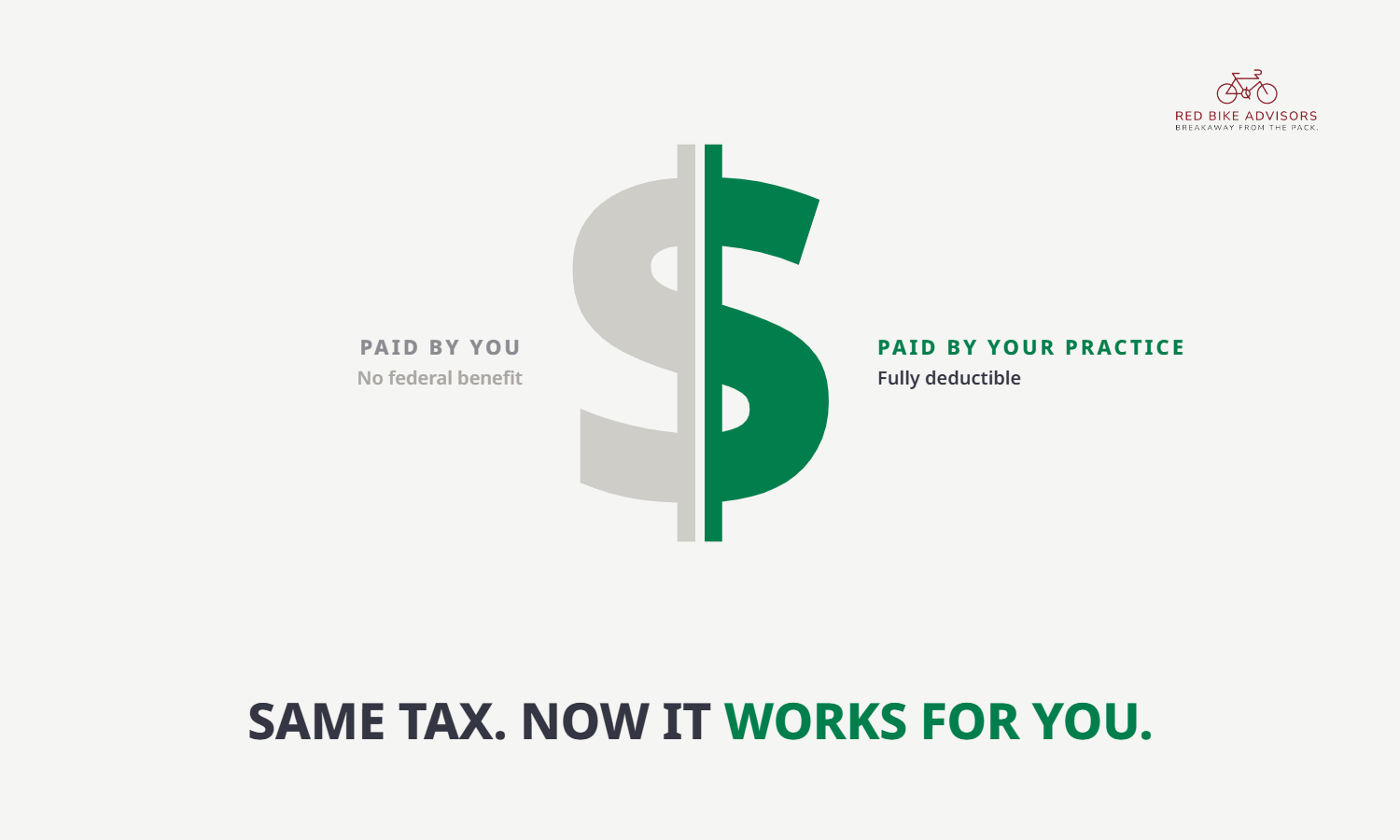
How much did your state income tax save you on your federal return last year?
If you take the standard deduction, the answer might be nothing at all. Every dollar you paid your state came straight out of after-tax income, with no federal benefit attached.
For a profitable chiropractic practice, that can be $15,000, $20,000, or more a year doing no federal work for you. There is a way to change that. Whether it fits your practice comes down to a few specific questions.
What is the pass-through entity tax election?
The pass-through entity tax (PTET) election lets your practice pay your state income tax at the entity level instead of on your personal return. Because the practice pays it, it becomes a business deduction on the federal return, outside the personal cap on state and local tax (SALT) deductions.
The IRS confirmed this treatment in Notice 2020-75. As of late 2025, 36 states had enacted some version of a PTET (state PTE tax map), and the One Big Beautiful Bill Act left these elections intact. A few state programs have expired or are set to expire, so confirm your state's current status before you plan around it.
In plain terms: the same state tax dollars move from a deduction you may not be able to use to a deduction you almost certainly can.
Why does this matter if the SALT cap went up in 2026?
The SALT cap did go up. For 2026, it's $40,400 (Congressional Research Service). But there are two catches.
First, it phases down once your modified adjusted gross income passes $505,000, shrinking by 30 cents for every dollar over that line, and it bottoms out at $10,000 around $606,000 of income.
Second, the SALT deduction only helps if you itemize. The 2026 standard deduction for married couples filing jointly is $32,200 (Rev. Proc. 2025-32). If your itemized deductions don't beat that, your state income tax gives you zero federal benefit.
A lot of chiropractors fall into one of those two groups. PTET works around both.
Does your chiropractic practice qualify for the PTET election?
Three things have to line up:
- Your state has to offer it. Not every state does, the rules vary quite a bit, and some programs are temporary.
- Your practice has to be taxed as an S-Corp or partnership. A single-member LLC that's taxed as a sole proprietorship generally can't make the election in most states.
- The owners have to agree. In a multi-owner practice, some states require every owner to consent, or at least to be affected the same way.
If your practice is still a sole proprietorship for tax purposes, PTET is one more reason to review your structure. That's a conversation for well before year-end.
What is the PTET election actually worth?
Here's how the math works for a chiropractic practice netting $420,000, with owners who take the standard deduction. (Illustrative numbers; your state, bracket, and income will change the result.)
- State income tax on that income at about 5%: $21,000
- Federal benefit from that state tax when paid personally: $0
With the PTET election, the practice pays the $21,000. Your federal taxable income drops by $21,000. At a 32% federal bracket, that's roughly $6,700 in federal savings in year one, before a few smaller interactions a projection should model.
On the state side, you generally get a credit or exclusion for the tax the practice paid, so you aren't paying the state twice.
Same $21,000 of state tax. About $6,700 of savings.
What are the catches?
PTET is powerful, and it isn't automatic. A few things to watch:
- Timing. For a cash-basis practice, the payment generally has to be made by December 31 to deduct it on your 2026 federal return. Some states have earlier deadlines or require a prepayment during the year, so check your state's calendar now.
- Double payments. If the practice pays state tax through PTET, your personal state estimates usually need to come down. Otherwise you're paying twice and waiting on a refund.
- Multi-state owners. If you live in one state and practice in another, the credit rules can get complicated fast.
- Election mechanics. Some states make you elect on a timely filed return. Others require an election during the year. Miss the window and you wait a year.
Each one is a reason to decide in October instead of December.
Why is October the right time to decide?
Because the payment has to be sized and sent before December 31, and it has to be coordinated with your fourth-quarter state estimate.
A clean October sequence looks like this: model the election, confirm your state's election rules, have the practice pay its state tax before mid-December, and lower your personal fourth-quarter state estimate to match. Your cash flow barely notices. Your federal return does.
The same state tax can be worth nothing on your federal return or worth thousands. The difference is who writes the check.
If you want to see how your practice's profitability compares to other chiropractic practices first, take our free Chiropractic Practice KPI Benchmark assessment: https://redbikeadvisors.com/resources/chiropractic-practice-assessment
Gretchen Roberts
Gretchen Roberts is CEO of Red Bike Advisors LLC. As a business owner herself, Gretchen has a deep understanding of the problems, questions, and financial pain points that business owners experience on a daily basis, and how strategic financial and tax planning is the key to "breakaway" business growth and success.