
Why Is October the Best Month to Review Your Dental Practice Tax Strategy?

By Gretchen Roberts
There's a short window every year when your tax bill stops being a guess and is still something you can change.
It's shorter than most practice owners expect. And once it closes, the best year-end moves disappear one at a time, usually while you're busy treating patients.
If you've ever sat down in December and asked "What can we still do?" you've felt that window close.
Why is October the best month to review your dental practice tax strategy?
October is the first month of the year when you have enough real numbers to project your tax bill accurately and still enough time to change it.
By early October, nine months of production and collections are on the books. Your third quarter is closed. You know whether the new associate ramped up, whether PPO writeoffs shifted, and whether hygiene is running full.
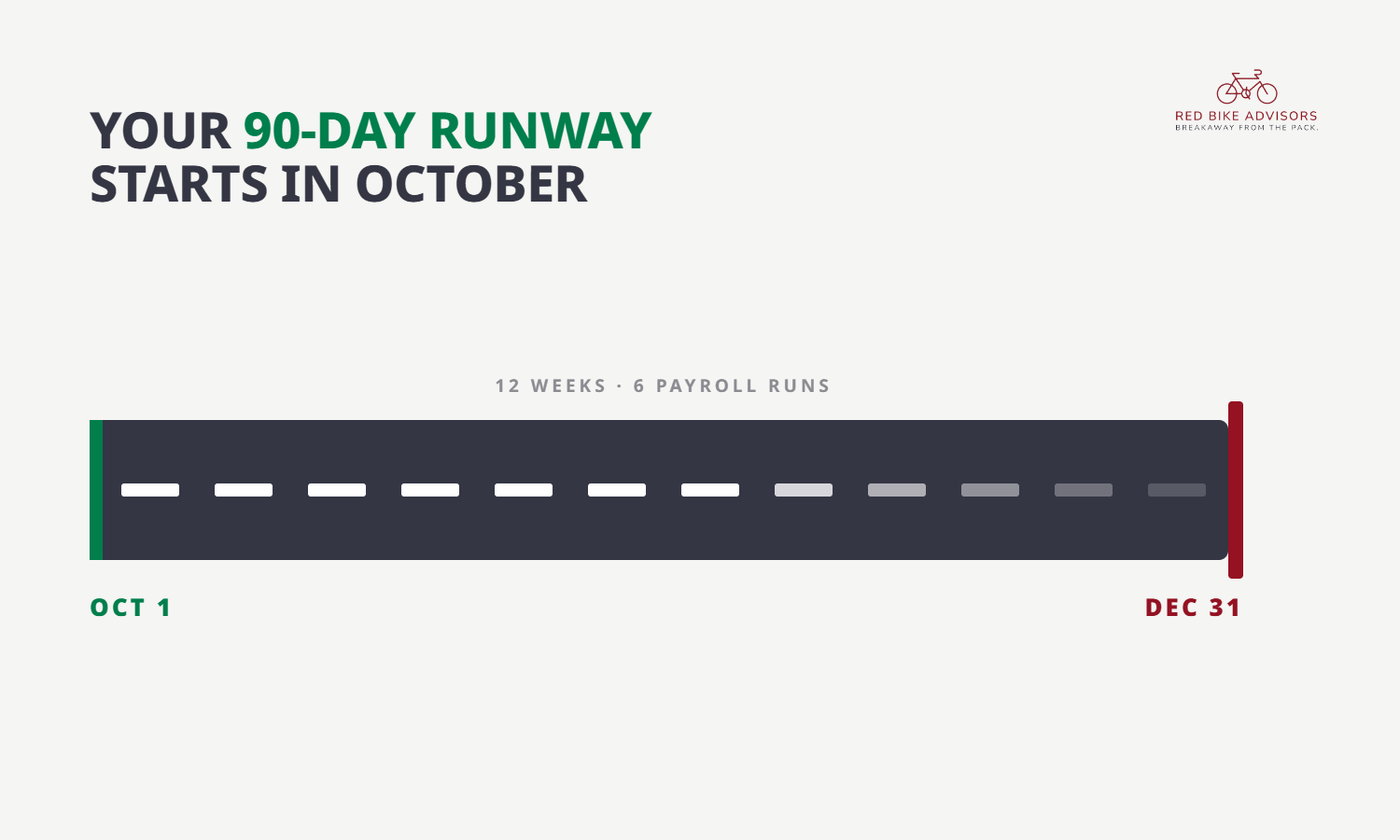
And you still have roughly 12 weeks and six or seven payroll runs before December 31. That's enough runway for the moves that need lead time.
I call this the 90-day runway. Start in October, and you get to use all of it.
Why can't you just plan in the spring or summer?
Early planning is useful. Finishing the plan early is where it falls apart.
A June projection is built on half a year of data and a lot of assumptions. For a dental practice, the back half of the year can look different from the front half. Most dental plans reset their annual maximums on January 1, with no rollover of unused benefits, and some patients schedule treatment in the fall to use what's left before it expires (ADA Health Policy Institute) [insert ADA link].
If you plan in June, you're guessing at months that haven't happened yet.
If you plan in October, you're working with facts.
Which tax moves need lead time before December 31?
This is where October earns its reputation. Several of the most valuable year-end moves can't happen on December 28, no matter how motivated you are.
- Equipment has to be installed and in service by December 31. To deduct a new CBCT, intraoral scanner, or chair package on your 2026 return, it generally has to be ready to use by year-end (IRS Publication 946). Vendor lead times of four to eight weeks are common. Under the One Big Beautiful Bill Act, 100% bonus depreciation is now permanent for qualifying property acquired after January 19, 2025 (Congressional Research Service), so the deduction can be large. But only if the delivery date cooperates.
- Owner salary changes run through payroll. If your practice is an S-Corp and your salary needs to go up or down to stay reasonable, that change has to flow through your remaining payroll runs. Six runs gives you room. One run gives you a very strange-looking December paycheck.
- Your fourth-quarter estimate. The final 2026 federal estimated payment is due January 15, 2027 (IRS Form 1040-ES). October is when you decide whether that payment needs to grow, shrink, or stay put.
Every one of these gets harder with each week you wait.
What does waiting until December actually cost?
Here's how the math works for a practice collecting about $1.8 million a year.
Say you sit down with your accountant on December 12 and decide to buy a $95,000 intraoral scanner and CBCT package to lower your taxable income. Good plan. Bad timing.
If the vendor quotes five weeks for delivery and installation, the equipment goes into service in mid-January. The entire deduction slides into the following tax year.
At a 35% federal bracket, that's about $33,000 of tax savings you were counting on for April that simply isn't there. You get the deduction eventually. You just don't get it when you planned the cash around it.
Your salary has the same problem. If it needs to go up $40,000 to be defensible for your role and you have one payroll run left, the whole adjustment lands in a single December check.
Now run the same year starting in October. The equipment order goes in the second week of the month and is installed before Thanksgiving. The salary adjustment is spread across six payroll runs. Your fourth-quarter estimate is sized from an actual projection instead of last year's number.
Same practice. Same decisions. A completely different December.
How should you adjust your fourth-quarter estimated tax payment?
Start by comparing this year to last year.
If your estimates are based on last year's tax and your net income has gone way up, your payments are probably too small. A new associate, a full hygiene schedule, or a fee increase can push this year well past last year. The difference shows up in April, all at once.
If your net income has gone way down, you may be overpaying. That's cash the practice could be using for payroll or equipment, sitting with the IRS until you file.
Either way, the fix is the same. Project your full-year tax from nine months of real numbers, subtract what you've already paid through estimates and withholding, and size your January 15 payment to the real gap.
If you're behind, the safe harbor rule decides whether you also owe an underpayment penalty. In plain terms, it's the minimum you need to have paid in during the year to stay penalty-free, even if you still owe a balance in April.
What should you bring to an October tax review?
Bring five things:
- Year-to-date P&L and balance sheet through September 30
- Your year-to-date payroll register, including your own salary
- Every federal and state estimated payment you've made this year
- Your equipment wish list, with vendor lead times
- Last year's tax return
With those, a good advisor can project your year-end number, show you the gap, and build a plan that fits inside the 90-day runway.
October is when you still get to choose. December is when you find out what you chose
Our October calendar fills quickly, and the practice owners who start first get the most runway. If you want your numbers reviewed while there's still time to act on them, book a free strategy session: https://redbikeadvisors.com/book-a-free-strategy-session
Gretchen Roberts
Gretchen Roberts is CEO of Red Bike Advisors LLC. As a business owner herself, Gretchen has a deep understanding of the problems, questions, and financial pain points that business owners experience on a daily basis, and how strategic financial and tax planning is the key to "breakaway" business growth and success.