
Your Production Numbers Look Great. So Why Is There No Money Left?

By Gretchen Roberts
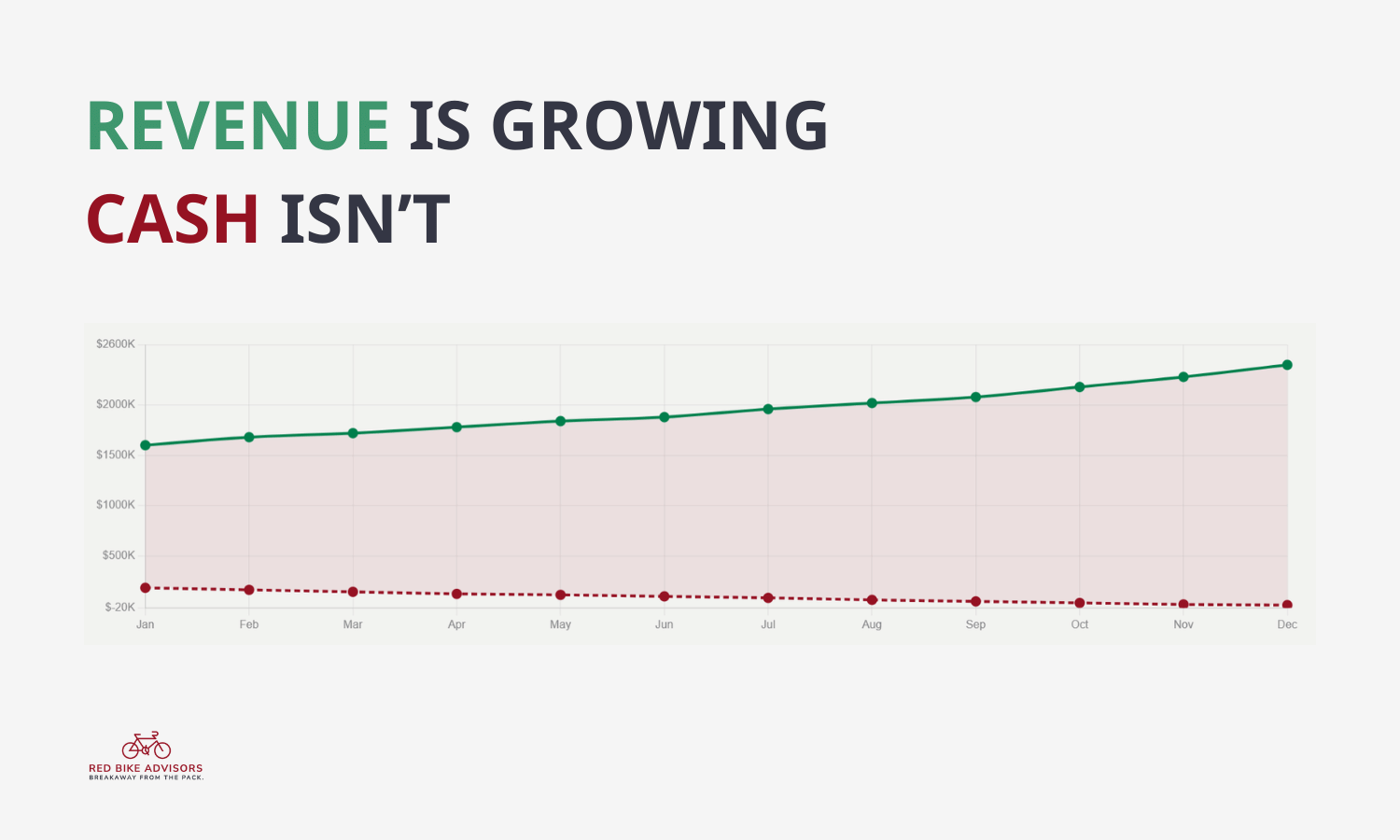
I was on a call recently with a dental practice owner who was genuinely confused.
Production was up. Patients were coming in. The schedule looked healthy.
And yet, at the end of every month, there was nothing left to take out of the practice.
No distributions. No cash cushion. Just a number on the P&L that did not match the reality in the bank.
Revenue does not lie. But it does not tell the whole truth either.
The Gap Between Production and Profit
This is one of the most common conversations I have with healthcare practice owners, and it is one of the most disorienting experiences you can have as a clinician who has built something.
You went to school. You built a patient base. You added staff, maybe a second location, maybe a partner. The top line is moving.
But the bottom line is not following.
In most cases, the answer is not that you have a revenue problem.
You have a cost structure problem. And the two look identical from the outside until you dig into the numbers.
What Was Actually Happening in That Practice
The practice I was working with had recently gone through a merger with a second location.
On paper, production was strong and trending in the right direction. But here is what was quietly eating the margin:
- Additional staff costs. The merged practice brought in new clinical and administrative team members. Payroll expanded before revenue from the second location had fully stabilized.
- Additional rent. Two locations meant two lease obligations. The second office was not yet generating enough production to carry its own overhead.
- Acquisition debt service. The original acquisition loan, equipment financing, and the new merger debt were all drawing from the same operational account every month. Principal payments do not show up on a P&L. They come off "below the bottom line” without a line item that makes the pain visible.
- Transition costs that had not fully phased out. Onboarding, credentialing, equipment setup, and other one-time costs were still working through the books.
None of these were surprises in isolation. Every one of them was a deliberate decision that made sense at the time.
The problem was that no one had modeled what all of them looked like together, on the same cash flow, at the same time.
The Debt Service Blind Spot
This is worth pausing on because it trips up practice owners constantly.
When you take on acquisition debt, equipment loans, or a line of credit, the monthly payment has two parts: interest and principal.
The interest portion is deductible and shows up on your profit and loss statement.
The principal portion does not. It comes off your cash. It reduces your bank balance. But it is invisible on the P&L because it shows up on your balance sheet as a paydown.
So a practice can look profitable on paper, with a positive net income on the P&L, while simultaneously running out of cash because significant money is leaving the account every month as debt repayment that the income statement never captures.
When I explain this to practice owners, the response is almost always the same.
"Why did no one ever tell me that?"
It is not obvious. And your accountant should be walking you through it.
Why Growth Can Make This Worse Before It Gets Better
There is a version of this story that ends well. The practice stabilizes, the transition costs phase out, production catches up to the expanded overhead, and cash flows normalize.
But there is also a version where the owner keeps adding, keeps expanding, keeps growing the top line, without ever pausing to ask whether the cost structure has caught up.
Every new hire is a fixed cost before they are profitable.
Every new location is an overhead obligation before it is a revenue generator.
Every piece of equipment carries a payment whether or not the chair is full.
Growth in a healthcare practice is not inherently bad. But growth without visibility into what it is costing you at the cash level is how practices end up profitable on paper and broke in practice.
Revenue is what you earn. Cash is what you keep. They are not the same number, and they are not calculated the same way.
What Clean Books Actually Reveal
The reason this problem persists for so many practice owners is that it is invisible without the right financial structure.
If your chart of accounts is not set up correctly, if expenses are miscategorized or lumped together, if debt service is not separated from operating costs, your P&L will tell you a story that is technically accurate and practically useless.
What you need to see clearly:
- True gross margin by service line. Are hygiene, restorative, and specialty procedures each carrying their weight? Or is one area subsidizing another without you knowing it?
- Overhead as a percentage of production. Benchmarked against industry standards for your practice type, this tells you whether your cost structure is sustainable or already under pressure.
- Cash flow separate from net income. A simple cash flow statement that shows you where money is actually going, including debt principal payments that never touch the P&L.
- Owner compensation in the right category. Many practice owners have personal expenses running through the business, or compensation that is misclassified. That distorts every other number on the statement.
This is the work we do before we make any recommendations about growth, hiring, or strategy. Because advice built on bad data produces bad outcomes, no matter how sound the logic.
The Conversation That Changes Everything
The practice owner I mentioned at the start of this post was not doing anything wrong.
They had made good decisions. They had grown. They had brought on a partner to expand capacity.
What they did not have was a clear picture of what all of those decisions looked like together in real time.
Once we worked through the actual cash flow, separated the debt service from operating expenses, and mapped out when the transition costs would fully phase out, the confusion lifted.
The practice was not in trouble. It was in a transition window that had a defined end.
They could see when cash flow would normalize, what it would take to get there, and what decisions would accelerate or delay that timeline.
That is what financial clarity does. It does not change the numbers. It changes what you can do with them.
What to Do If This Sounds Familiar
If you are a practice owner who is watching production climb while the cash balance stays flat or shrinks, start here:
- Pull your last three months of bank statements alongside your P&L. Do the numbers tell the same story? If the P&L shows profit but the bank balance is not growing, cash is being sucked away somewhere.
- Map your fixed obligations. List every debt payment, lease, payroll commitment, and recurring cost that goes out the door, regardless of how many patients you see. This is your floor. Production has to clear it before any profit exists.
- Separate debt principal from operating expenses. Ask your accountant to show you a cash flow statement, not just a P&L.
- Benchmark your overhead. Dental practices typically target total overhead in the 55 to 65 percent range. Medical and specialty practices vary. Where you land relative to your peers tells you a lot about whether you have a cost problem or a production problem.
And if you want a second set of eyes on the numbers, that is exactly what a strategy session is for.
Not a sales call. Not a pitch. Just a conversation about what your financials are actually telling you, and what to do about it.
Production tells you what your practice is capable of. Profit tells you what it is actually doing. If the two are not moving together, it is time to find out why.
Book a free strategy session at https://redbikeadvisors.com/book-a-free-strategy-session/.
Gretchen Roberts
Gretchen Roberts is CEO of Red Bike Advisors LLC. As a business owner herself, Gretchen has a deep understanding of the problems, questions, and financial pain points that business owners experience on a daily basis, and how strategic financial and tax planning is the key to "breakaway" business growth and success.