
Does Buying Supplies in December Actually Save Your Dental Practice Money on Taxes?

By Gretchen Roberts
Dental supply reps love December.
Somewhere, a practice owner just heard the most expensive six words in year-end tax planning: "Stock up. It's a write-off."
It sounds like smart planning. A big order goes in, the bank balance drops, and the tax bill is supposed to drop with it.
Before you place that order this year, it's worth running the numbers, because the result is often the opposite of what you'd expect.
Does buying supplies in December save your dental practice money on taxes?
Sometimes, a little, and usually less than you think.
A December purchase moves a deduction you'd take anyway into an earlier year. That only saves real money when three things are true:
- You were going to buy those supplies soon anyway
- The tax rules let you deduct them when you pay, instead of when you use them
- Your tax bracket this year is higher than it will be next year
If any one of those is false, the December order is either neutral or costing you money.
What is the 63-cent rule?
This is the simplest way I know to explain year-end spending.
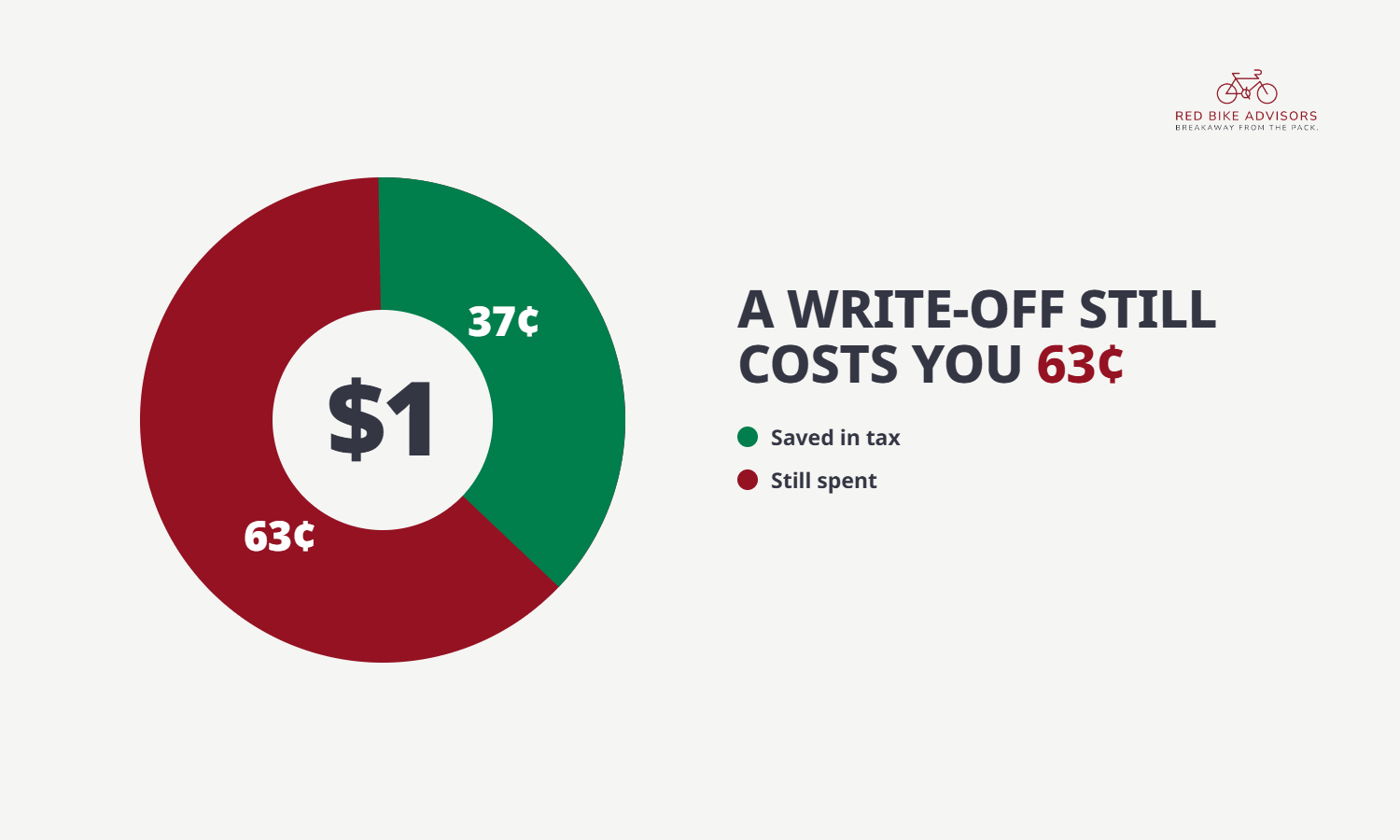
If you're in the 37% federal bracket, every $1 you spend on a deductible expense saves you 37 cents in federal tax. You're still out 63 cents.
So a $20,000 supply order saves about $7,400 in federal tax. It also costs you $12,600 in cash you'll never see again.
If you needed those supplies in January, great. You got them a few weeks early and moved a deduction forward.
If they'd sit in a closet until next summer, you just spent $12,600 to avoid $7,400 of tax.
A deduction is a discount on something you were already going to buy.
Can you deduct dental supplies when you buy them, or only when you use them?
This is the part that rarely comes up at the supply counter.
Under the IRS materials and supplies rules, supplies you keep track of and use over time are generally deducted in the year you use them.
Two exceptions matter for dental practices:
- Incidental supplies. Low-cost items you don't track with inventory records can generally be deducted when you pay for them.
- The de minimis safe harbor. If your practice makes this annual election, items costing $2,500 or less per invoice or per item can be deducted when paid.
Here's the catch. If your practice uses supply management software that tracks what's on hand, a closet full of composite, gloves, and impression material bought on December 20 may not produce a 2026 deduction at all. It's a 2027 deduction you paid for early.
What about prepaying rent, insurance, or subscriptions?
Prepaying can work, with limits.
Under the 12-month rule, a cash-basis practice can generally deduct a prepaid expense in the year it pays, as long as the benefit doesn't extend beyond the earlier of 12 months after it starts or the end of the next tax year.
So paying in December for a malpractice policy or software subscription that runs January through December 2027 can work. Paying for 18 months of rent generally can't.
The 63-cent rule still applies. You're moving cash out of your account earlier. Make sure the practice can afford it.
When does year-end timing actually save money?
Timing creates real savings when your tax rate changes between years. And it can work against you when your rate is going up.
Here's how the math works for a practice with a new associate ramping up. Say your projection shows about $390,000 of taxable income this year, which puts you in the 24% federal bracket, and the associate's growth is on track to push you into the 32% bracket next year (2026 brackets per Rev. Proc. 2025-32).
Now say you're planning a $38,000 December supply order.
At 24%, that deduction is worth about $9,120 this year.
At 32%, the same deduction would be worth about $12,160 next year.
The December order costs you roughly $3,000 in extra tax, plus $38,000 of cash tied up in inventory. In that situation, the smart move is to wait.
The reverse is true too. If this is your biggest year and next year will be smaller, pulling legitimate expenses forward can make a lot of sense.
What should you review in October?
- A two-year projection. You need this year's and next year's likely brackets to know which direction timing should go.
- Your supply spend against benchmark. Healthy dental practices typically keep supplies around 4% to 6% of collections (Red Bike Advisors KPI benchmarks). If you're already above that, a December stockpile makes the ratio worse.
- Whether your practice has made the de minimis safe harbor election. It's made annually with your tax return.
- Which prepaid expenses fit the 12-month rule.
A tax deduction is a terrible reason to buy something and a great bonus on something you needed.
See how your supply and overhead ratios compare with our free Dental Practice KPI Benchmark assessment: https://redbikeadvisors.com/resources/dental-practiceassessment
Gretchen Roberts
Gretchen Roberts is CEO of Red Bike Advisors LLC. As a business owner herself, Gretchen has a deep understanding of the problems, questions, and financial pain points that business owners experience on a daily basis, and how strategic financial and tax planning is the key to "breakaway" business growth and success.