
The 5 Biggest Profit Leaks in a Growing Healthcare Practice (And How to Find Yours)

By Gretchen Roberts
What are the most common profit leaks in a growing healthcare practice?
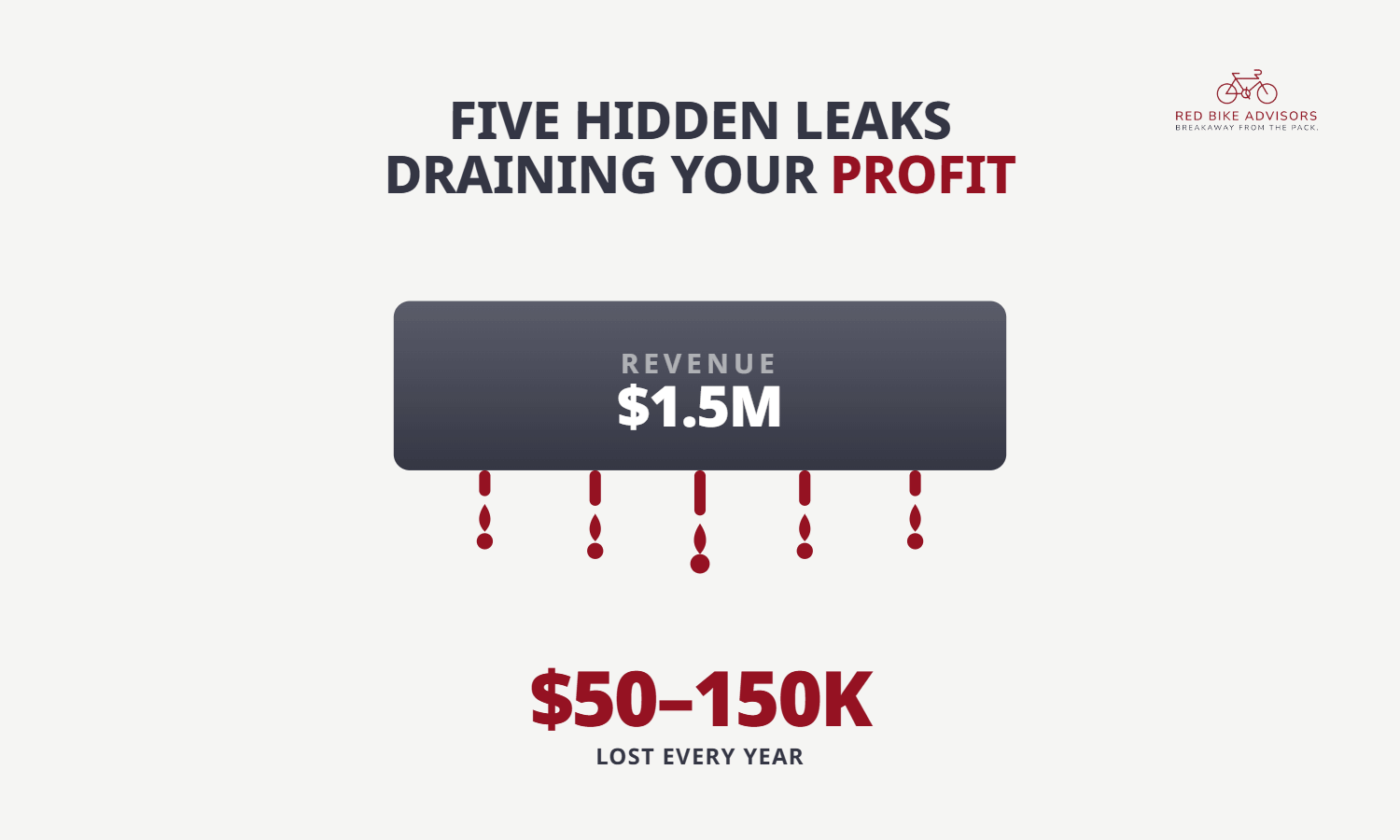
A growing healthcare practice can be generating strong revenue while quietly losing $50,000 to $150,000 per year to controllable profit leaks. These are not obvious failures. They are structural inefficiencies that compound over time, typically in staffing, billing, overhead, owner compensation, and tax planning. Most practice owners discover them only when they finally have a proactive financial review done. Here are the five most common ones and how to find yours.
Profit Leak 1: Staff costs that grew faster than revenue
The pattern: The practice added staff over time in response to patient volume. Revenue grew. Staff costs grew faster. Nobody stepped back to evaluate the staffing structure against current revenue.
The benchmark: Staff costs should be 23% to 35% of revenue depending on specialty. A practice running 38% to 42% staff costs is losing significant margin to a cost that feels necessary but has become structural overspend.
The fix is rarely staff reductions. It is usually a productivity conversation: revenue per employee, scheduling efficiency, and whether the right tasks are being handled at the right compensation level. A target of $150,000 to $200,000 in revenue per employee is a reasonable starting point for most healthcare practices.
Profit Leak 2: A billing process that is not capturing everything it earned
The pattern: The practice produces high-quality care. The billing process has gaps. Insurance denials go unworked. Patient balances age past 90 days without follow-up. The collections rate sits at 88% to 92% when it should be 96% to 98%.On a $1.5M production base, the difference between a 90% collection rate and a 97% collection rate is $105,000 in annual revenue. That money was earned. It just was not collected.
Billing is the highest-leverage improvement area in most practices because the revenue already exists. It just needs to be captured.
Profit Leak 3: Overhead that no one audited
The pattern: Software subscriptions auto-renewed. Vendor contracts were never renegotiated after the practice grew. Rent was locked in before volume caught up. Small costs accumulated across many line items, none of which individually felt worth addressing.The benchmark for non-staff, non-clinical operating overhead in most healthcare practices is 18% to 22% of revenue. A practice running 27% to 30% has $50,000 to $80,000 in annual overhead that likely contains recoverable dollars.
A quarterly overhead review that asks "do we still need this, and are we paying the right price for it" is one of the highest-return hours in practice management.
Profit Leak 4: Owner compensation that is not structured for tax efficiency
The pattern: The owner draws a salary. Nobody has reviewed whether that salary is structured to minimize payroll taxes while remaining defensible to the IRS. The entity structure was set up years ago and has never been revisited as the practice grew.
For an S-Corp owner, every dollar of profit taken as a distribution rather than salary avoids 15.3% in payroll taxes up to the Social Security wage base. On $100,000 in reclassified compensation, that is $15,300 in annual tax savings. The structure requires documentation and an annual review. Most practice owners have never had either.
Profit Leak 5: No proactive tax planning
The pattern: Tax returns are accurate. Tax strategy does not exist. The practice pays whatever the reactive accountant calculates after the year ends, with no mid-year projections, no retirement plan optimization, no equipment timing, and no entity structure review.
In practices doing $1M to $5M in revenue, proactive tax planning typically identifies $20,000 to $80,000 in annual tax reduction opportunities. These are not aggressive strategies. They are standard planning moves that require a conversation before December 31, not after.
How to find your practice's profit leaks
The first step is a benchmarking exercise: compare every major cost category in your practice against industry standards for your specialty and revenue level. The gaps between your actual numbers and the benchmarks tell you where the leaks are.
That is exactly what the free strategy session is designed to surface. It is not a sales call. It is a diagnostic.
Book a free strategy session to identify the profit leaks in your practice: https://redbikeadvisors.com/book-a-free-strategy-session/
Gretchen Roberts
Gretchen Roberts is CEO of Red Bike Advisors LLC. As a business owner herself, Gretchen has a deep understanding of the problems, questions, and financial pain points that business owners experience on a daily basis, and how strategic financial and tax planning is the key to "breakaway" business growth and success.